
TikTok Fashion Ads: Faceless Creative That Drives ROAS

This article breaks down how fashion and beauty brands can overcome creative fatigue and improve ad performance by producing faceless TikTok ads. It’s for performance marketers and founders who need a scalable way to create engaging video creative without relying on models or photoshoots.
- Discover why product-focused, faceless creative resonates with TikTok users.
- Learn proven formats for faceless ads that convert for fashion and apparel.
- Understand how to use AI to generate diverse, on-brand faceless video creative at scale.
- Identify the key metrics to measure the success of your faceless ad campaigns.
Are your TikTok ads burning out faster than you can replace them? For many fashion and beauty brands, the relentless need for new creative leads to high production costs and diminishing returns. The solution lies in shifting focus from models to the product itself with faceless creative—a strategy that aligns perfectly with TikTok's native feel and can significantly improve your Return on Ad Spend (ROAS).
Why does faceless creative connect so well on TikTok?
Faceless creative succeeds on TikTok because it mirrors the authentic, user-generated content (UGC) style that dominates the platform. Unlike polished, high-production ads that feel disruptive, faceless videos centered on the product feel more native and less like a hard sell. This approach lowers the viewer's natural aversion to advertising, encouraging them to watch longer and engage more deeply. It taps into the audience's desire for content that feels real and attainable, rather than aspirational and distant. The psychology behind this is simple: when content looks like it was made by a peer, it's perceived as a recommendation rather than an advertisement, fostering a sense of trust and community.
This style allows the product to be the hero. Close-ups on fabric texture, a unique design detail, or the satisfying unboxing experience can create a powerful sensory connection that a model-focused ad might obscure. According to TikTok's own creative principles, ads that align with organic trends and user behaviors see a significant lift in performance. Faceless content, such as "Get Ready With Me" (GRWM) videos that only show hands and the product, fits this mold perfectly, making the viewer feel like they are part of the experience. It removes the potential distraction of a model and focuses the entire narrative on the item you want to sell, making its value proposition crystal clear.
Which faceless ad formats convert best for fashion brands?
Several faceless ad formats have proven effective for driving conversions in the fashion and beauty sectors. These formats are easy to produce, require minimal equipment, and can be created in batches to feed the ever-hungry TikTok algorithm. The key is to focus on visual storytelling that highlights the product's best features in a native, engaging way. Successful brands often build a content matrix, testing combinations of these formats against different trending sounds and hooks to discover their own unique formula for success.
- Product-in-Action Shots: Think satisfying ASMR-style videos. A shoe stepping into a puddle to show it's waterproof, the smooth application of a cosmetic, or the satisfying zip of a handbag. These highlight quality and function in a visually engaging way that captures attention in the first few seconds. This format is excellent for demonstrating durability and material quality, answering potential customer questions before they're even asked.
- Unboxing & Packaging Focus: The unboxing experience is a powerful retention tool and a key part of the customer journey, especially for D2C brands. A well-filmed sequence showing premium packaging and the first reveal of the product can build significant perceived value and desire. It transforms a simple purchase into a luxury experience, justifying a higher price point and building brand loyalty.
- Flat Lays & Stop Motion: Dynamic flat lays or simple stop-motion videos showing an outfit being assembled piece-by-piece are visually arresting and keep viewers watching. They are a creative way to showcase styling, product combinations, and versatility without needing a model. This format allows for immense creativity in a controlled environment and is perfect for highlighting entire collections or "shop the look" campaigns.
- Detail-Oriented Close-Ups: Zoom in on what makes your product special. The intricate stitching on a garment, the unique clasp of a necklace, or the rich texture of a fabric. These shots communicate quality and craftsmanship without a single word and are highly effective for luxury or high-consideration items. This builds trust and positions your product as a premium choice.
- Aesthetic "Day in the Life" Snippets: Show the product being used in a relatable, aspirational context, but keep the focus tight on the product. A hand carrying a coffee and your handbag, a shot of stylish shoes walking through a chic location. This creates a powerful lifestyle narrative and helps the viewer imagine the product in their own life, all without the cost or complexity of hiring models.

How can AI generate high-performing faceless TikTok ads?
The primary challenge with TikTok advertising is producing enough creative to avoid ad fatigue, where users see the same ad so often they stop responding, causing CPA to rise and ROAS to fall. AI platforms like EngageReel are designed to solve this exact problem. By leveraging generative AI, brands can turn static product photos into dozens of unique, faceless video ad variations in minutes, not weeks. This continuous stream of fresh creative keeps campaigns effective for longer and provides a wealth of data on what resonates with your audience.
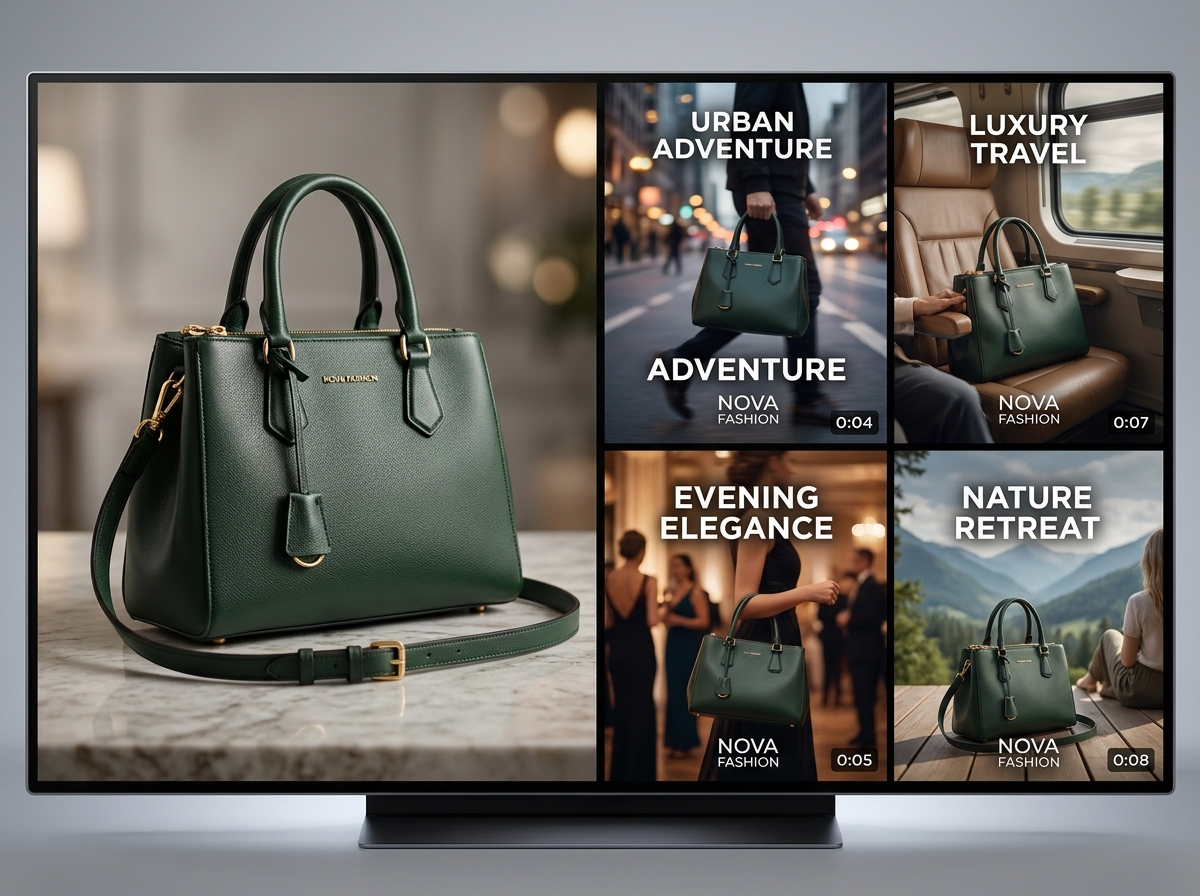
The process starts with your existing product catalog imagery. An AI content engine can take a single flat-lay or packshot and generate multiple video formats based on proven, high-converting templates. For example, it can place your product into different lifestyle backdrops, animate it for a stop-motion effect, or generate hands interacting with it for an unboxing sequence. This allows for rapid, low-cost testing of different creative angles—different hooks, calls-to-action, and visual styles—without needing a new photoshoot for every idea. This agility is crucial for keeping up with fast-moving TikTok trends and outmaneuvering competitors.
Furthermore, the most advanced AI tools integrate creative production with performance analytics. They can analyze real-time data from your live campaigns to identify which creative elements—hooks, music, pacing, visual styles—are driving the best results (e.g., highest CTR, lowest CPA). The system then automatically generates new creative variations based on those winning patterns. This creates a powerful, data-driven feedback loop where your ad creative is constantly evolving and improving, scaling your ROAS without scaling your team's workload. It moves creative strategy from guesswork and manual iteration to a predictable, automated science.
| Aspect | Manual Creative Process | AI-Powered (EngageReel) |
|---|---|---|
| Time to Create | Days or Weeks (per batch) | Minutes |
| Required Assets | Video footage, models, location, editors | Static product images from your catalog |
| Volume & Variation | Low, expensive to scale, slow to test | High, easy to test dozens of angles simultaneously |
| Performance Feedback | Manual analysis, often delayed and subjective | Automated, real-time insights drive next-gen creative |
Where does EngageReel fit into this strategy?
EngageReel is an AI ad performance and creative platform built specifically for the demands of fashion ecommerce. Its Content Engine is designed to generate high-performing, faceless video ads at scale directly from your existing product catalog. By automating the production of diverse, on-brand creative and connecting it directly to ad performance data, EngageReel helps brands break the cycle of creative fatigue and unlock higher, more consistent ROAS. It provides the volume, speed, and intelligence needed to win on competitive platforms like TikTok, turning your product feed into a perpetual motion machine for high-performing video ads. You can learn more at EngageReel.com.
What metrics matter most for faceless ad performance?
While ROAS is the ultimate measure of success, it's a lagging indicator. To effectively manage and optimize your campaigns in real-time, you need to monitor several leading indicators that signal whether your faceless creative is resonating with your audience. Tracking these allows you to make agile adjustments before you burn through your budget, ensuring you're only scaling what works and learning from what doesn't.
Focus on early engagement signals. On TikTok, the first few seconds are everything. A high 2-second view rate and 6-second view rate are critical. If users aren't watching past the initial hook, your ad will never get the chance to convert. This is your first and most important battle. A/B test different opening shots, on-screen text hooks, or initial sounds to improve this crucial initial retention. Even a small lift here can have a massive downstream impact on your overall campaign performance.
Next, look at Click-Through Rate (CTR). While a high view rate is good, it means little if users aren't compelled to take the next step and visit your site. A strong CTR for fashion brands on TikTok is typically above 1%, but this can vary. If your CTR is low, your call-to-action (CTA) may be weak, the creative may not be generating enough desire for the product, or your targeting might be off. Test different CTA button text, placements, and even the timing of the CTA within your video. Finally, monitor your Cost Per Acquisition (CPA). This tells you exactly how much you're paying to acquire a new customer and is a core measure of campaign efficiency. A successful faceless ad campaign should not only have a strong ROAS but also a sustainable CPA that aligns with your product margins and business goals. Directional ROAS benchmarks for fashion and apparel on TikTok can range from 2.2x to 3.2x, as noted by industry analyses, providing a useful yardstick for your own performance. (Hawky.ai, 2026).
Frequently asked questions
What is a faceless TikTok ad?
A faceless TikTok ad is a video creative that focuses on the product, its features, or its use case without showing a person's face. The style often mimics native UGC content and can include shots of hands, close-ups of the product in action, or aesthetic lifestyle snippets where the user's face is out of frame. The goal is to make the ad feel less like a commercial and more like an authentic discovery or recommendation from a peer.
Can fashion brands succeed on TikTok without showing models?
Absolutely. Many fashion brands thrive on TikTok by creating product-centric content that feels authentic to the platform. By focusing on details, quality, and creative storytelling through formats like unboxing, stop-motion, and ASMR-style videos, brands can build desire and drive sales without the cost and complexity of model-based photoshoots. It puts the product at the center of the story, making it the star of the show.
How long should a faceless TikTok ad be?
The optimal length for a TikTok ad is between 15 and 30 seconds. The most crucial part is the first 2-3 seconds, which must grab the viewer's attention immediately with a strong visual hook. Your ad should be long enough to showcase the product's key value proposition and present a clear call-to-action, but short and punchy enough to retain viewer attention in a fast-paced, scroll-heavy feed. Brevity and impact are key.
What kind of music works best for faceless fashion ads on TikTok?
Trending audio is key to success on TikTok. Using songs or sounds that are currently popular on the platform can significantly increase your ad's relevance and potential reach, as the algorithm favors content using these sounds. The TikTok Creative Center is an invaluable resource for discovering trending audio. The music should always match the mood of your ad—upbeat for energetic visuals, or lo-fi and chill for aesthetic, detail-oriented shots. Always ensure you have the proper commercial licenses to use the audio in your ads to avoid any legal issues.
How many creatives do I need to test for a TikTok campaign?
For a typical TikTok campaign, it's recommended to start with at least 3-5 different creative variations in each ad set. This allows the algorithm enough options to find the best-performing ad for your target audience and helps prevent creative fatigue from setting in too quickly. Using an AI tool to generate these variations from a single product image is a highly cost-effective way to produce the volume needed for effective, continuous testing and optimization.