
How to Test New Hooks Using Meta Dynamic Creative
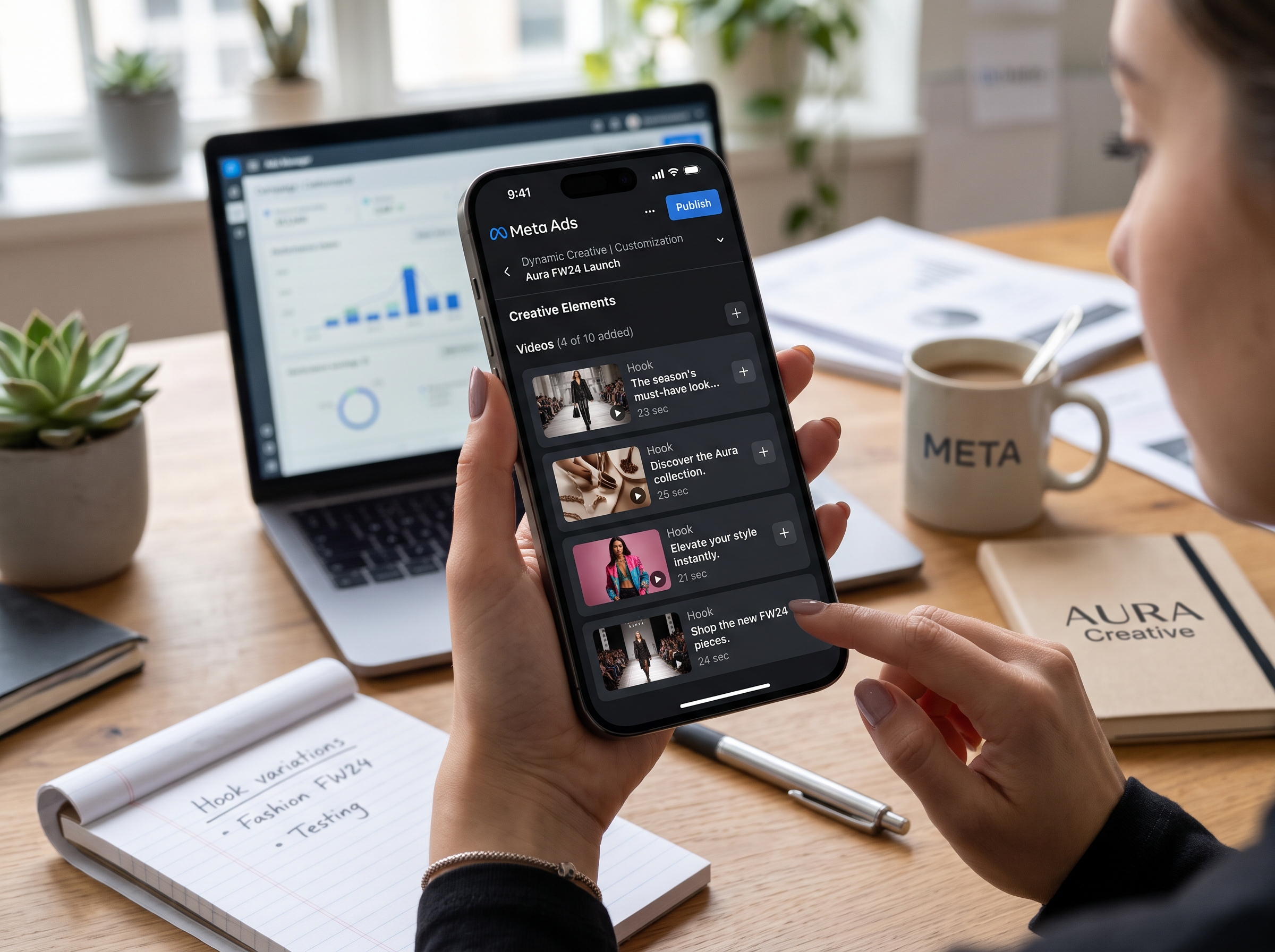
Media buyers and D2C creative strategists managing paid social video ads often struggle to isolate why a winning ad fatigued without fragmenting budget or resetting Meta's learning phase. This guide details a systematic framework for testing multiple 3-second opening clips using Meta Dynamic Creative (DCT) and Flexible Formats.
- Structure a single dynamic creative asset group with one standardized body video and 3 to 5 distinct hooks.
- Distinguish between 3-second video view rate (hook rate) and thumbstop efficiency to evaluate creative strength.
- Verify actual delivery across creative assets using Meta breakdown reports rather than assuming even budget distribution.
- Explore how Engagereel automates creative testing and campaign optimization for fashion and beauty brands.
How do you test new hooks using Meta dynamic creative without splitting budgets or resetting campaign learning? The most efficient method for e-commerce performance marketers is uploading a standardized body video paired with three to five distinct 3-second opening hook clips into a single dynamic creative asset group. According to Meta Business Help Center (2026), dynamic creative allows advertisers to automatically combine creative elements while measuring performance at the asset level, making it the premier framework for isolating hook effectiveness before committing major ad spend.
Why Use Meta Dynamic Creative (DCT) for Video Ad Hook Testing?
Creative fatigue is the primary silent killer of return on ad spend (ROAS) for D2C fashion and beauty brands. When a winning video ad plateaus, media buyers face a critical dilemma: building separate ad sets for every new hook variation fractures the daily budget and forces campaigns back into Meta's learning phase, which destabilizes cost per acquisition (CPA).
Meta Dynamic Creative (DCT) solves this structural bottleneck. Instead of duplicating ad sets, you consolidate spend into a single campaign while allowing the auction algorithm to test multiple video clips, primary texts, headlines, and calls to action simultaneously. Research by eMarketer (2025) indicates that brands utilizing automated creative variation testing achieve a 28% reduction in customer acquisition cost compared to static manual testing silos.

Step-by-Step Setup: Structuring Your Video Hook Test in Meta Ads Manager
Executing a clean hook test requires rigorous creative hygiene. If your body videos differ alongside your hooks, Meta's attribution cannot isolate whether the winning metric came from the opening three seconds or the middle demonstration.
Follow this exact meta ads dct hook testing framework to configure your campaign:
- Keep the core body video identical across all variations (from second 3 onward, the footage, audio track, pacing, and demonstration remain unchanged).
- Produce three to five distinct 3-second opening hooks that target different psychological triggers (e.g., visual product closeup, a direct problem-statement callout, an unboxing reveal, or a social proof quote).
- Navigate to Ads Manager, select Advantage+ Campaign Budget or set a dedicated ad set budget, and toggle Dynamic Creative to On.
- Upload your standardized body video and attach your distinct hook clips as video variations within the media asset customization panel.
- Publish the ad set and allow sufficient spend accumulation before pulling asset-level breakdown reports.
How Do You Analyze Hook Rate vs Hold Rate in Meta DCT Reports?
Traditional metrics like Click-Through Rate (CTR) and Cost Per Click (CPC) do not tell the whole story when evaluating top-of-funnel video creatives. In dynamic creative testing, media buyers must analyze two core video engagement metrics: hook rate and hold rate.
Hook rate measures the percentage of impressions that resulted in a 3-second video view (3-Second Video Views divided by Impressions). This isolates the stopping power of your opening hook. Hold rate measures how many viewers stayed through to completion or a substantial milestone (ThruPlay divided by 3-Second Video Views), which evaluates the quality and relevance of your core body video.
| Metric Name | What It Measures | Target Benchmark (Fashion & Beauty) |
|---|---|---|
| Hook Rate (3-Sec View Rate) | Opening visual and text stopping power | 35% to 45%+ |
| Hold Rate (ThruPlay / 3-Sec) | Core body narrative retention and product interest | 15% to 25%+ |
| Outbound CTR | Intent to purchase or browse catalog | 1.5% to 2.5%+ |
Overcoming Budget Distribution Misconceptions in Meta DCT
A widespread misconception among media buyers is that Meta Dynamic Creative automatically distributes impression budget equally among all tested video hooks. In reality, Meta's delivery system prioritizes assets that show early predictive signals of engagement during the initial delivery phase.
To verify which hook actually received sufficient delivery, you must never rely on top-level ad set performance. Instead, navigate to the Breakdowns menu in Ads Manager, select By Asset, and filter by Video. This exposes the exact spend, impressions, and conversions attributed to each individual hook variation, ensuring you do not kill a promising variation prematurely due to algorithm skew.
When Should You Graduate Winning Hooks into Standalone Scaling Ads?
Dynamic Creative is an exceptional sandbox for discovery, but it is rarely the optimal vehicle for massive scale. Once Meta's asset-level breakdown confirms a clear winning hook with strong statistical significance and low CPA over a 7-day window, you should graduate that asset.
Extract the winning 3-second hook spliced with the core body video, build a dedicated single-media ad within your primary scaling campaign or Advantage+ Shopping campaign, and allocate scaled budget behind it. This protects your scaling budget from intra-ad set auction competition while preserving proven creative winners.

How Engagereel Streamlines Creative Intelligence and Hook Testing
Managing dozens of video hook variations across multiple campaigns quickly overwhelms manual spreadsheets. Engagereel automates creative-to-performance tagging, mapping every hook, model, and scene directly to downstream ROAS and CPA in live Meta, Google, and TikTok accounts. By identifying fatigue patterns before they spike your acquisition costs, Engagereel empowers D2C fashion and beauty brands to generate high-converting variations on autopilot.
Frequently asked questions
How many video hooks should you test in a single Meta Dynamic Creative test?
Testing between 3 to 5 distinct video hooks in a single Dynamic Creative asset group is optimal for fashion and beauty brands. Exceeding 5 variations often starves strong hooks of necessary delivery data before Meta's delivery algorithm allocates sufficient statistical budget.
Does Meta Dynamic Creative spread budget evenly across all tested video hooks?
No. Meta Dynamic Creative does not distribute impression budget equally. The delivery system dynamically shifts budget toward assets showing immediate positive engagement signals. According to [Meta for Business (2026)](https://www.facebook.com/business/ads), advertisers must check asset-level breakdown reports to verify actual delivery distribution rather than assuming uniform spend across all variations.
What is a good hook rate for fashion and beauty Meta video ads?
For top-performing D2C fashion and beauty video ads, a healthy 3-second hook rate ranges between 35% and 45% or higher. Anything below 25% typically indicates that the opening visual or text overlay fails to stop the mobile scroll effectively.
Can you use Flexible Ad Formats instead of legacy Dynamic Creative for hook testing?
Yes. Meta's newer Flexible Ad Formats and Advantage+ creative customizations provide similar modular element testing capabilities. Both frameworks allow advertisers to upload multiple media components while maintaining consolidated campaign attribution and avoiding learning phase resets.
How should you handle winning hooks once identified in Meta DCT reports?
Once asset-level breakdown reports confirm a winning hook with sustained low CPA over a 7-day window, extract that exact creative combination into a dedicated single-media ad within your scaling campaign. This allows you to allocate heavy ad spend without intra-ad set auction competition.
References
- Meta Business Help Center — About Dynamic Creative for Ads (2026)
- eMarketer — Automated Creative Testing and D2C Performance Benchmarks (2025)
- Meta for Business — Best Practices for Creative Optimization and Asset Delivery (2026)
- Baymard Institute — E-Commerce Video Engagement and User Attention Research (2025)
- Shopify Enterprise — Scaling Paid Social Advertising for High-Growth Apparel Brands (2025)