
Fashion Ad Hooks: How to Test & Optimize for Better ROAS

This article provides a step-by-step framework for creative strategists and performance marketers at fashion brands to effectively test ad hooks. You'll learn how to isolate creative variables, measure performance accurately, and use those insights to optimize for higher ROAS.
- Understand the role of the first 3 seconds in ad performance.
- Discover the most effective types of hooks for fashion and beauty.
- Implement a structured creative testing framework.
- Identify the key metrics that truly measure a hook's success.
Your best-performing ad is a goldmine of data, and its first three seconds are the most valuable asset. For fashion brands, the ad hook isn't just an introduction; it's the single most critical factor in stopping the scroll and determining whether your ad budget generates returns or gets wasted.
Defining the Ad Hook and Its Impact on Fashion ROAS
An ad hook is the first 3-5 seconds of a video ad. In the context of platforms like Meta (Facebook, Instagram) and TikTok, its sole job is to capture attention immediately and persuade a user to keep watching. For fashion and beauty brands, where visuals and trends move at lightning speed, a weak hook means the rest of your ad—no matter how brilliant—is never seen.
A strong hook directly impacts your bottom line. By capturing higher quality attention upfront, it leads to a better hook rate (3-second video plays divided by impressions), which signals to the ad platform that your creative is relevant. This relevance can lower your cost-per-mille (CPM), improve click-through rates (CTR), and ultimately drive a higher Return on Ad Spend (ROAS). An ineffective hook does the opposite, forcing the algorithm to charge you more to reach people and killing your campaign's profitability.
What are the most effective types of ad hooks for fashion and beauty?
While creativity is endless, most high-performing ad hooks in the fashion and beauty space fall into several established categories. Testing a mix of these is the fastest way to understand what resonates with your specific audience.
- Problem-Solution: Address a common customer pain point immediately. For a clothing brand, this could be "Tired of jeans that gap at the waist?" before showcasing a perfect-fit denim line.
- UGC & Testimonial: Start with an authentic-looking clip from a customer or creator. This format builds instant trust and social proof, looking native to the feed. Example: "This is the most comfortable dress I've ever owned."
- Trend-Jacking: Leverage a trending sound, meme, or challenge on TikTok or Reels. This makes the ad feel like organic content rather than a disruptive advertisement.
- Visual Spectacle / "Thumb-Stop": Use a visually arresting or unexpected scene. For fashion, this could be a dramatic fabric flow, a rapid style transformation, or a surprising product application.
- Direct Question: Engage the viewer directly by asking a question they're likely to have an opinion on. "Which of these outfits would you wear for a summer wedding?"
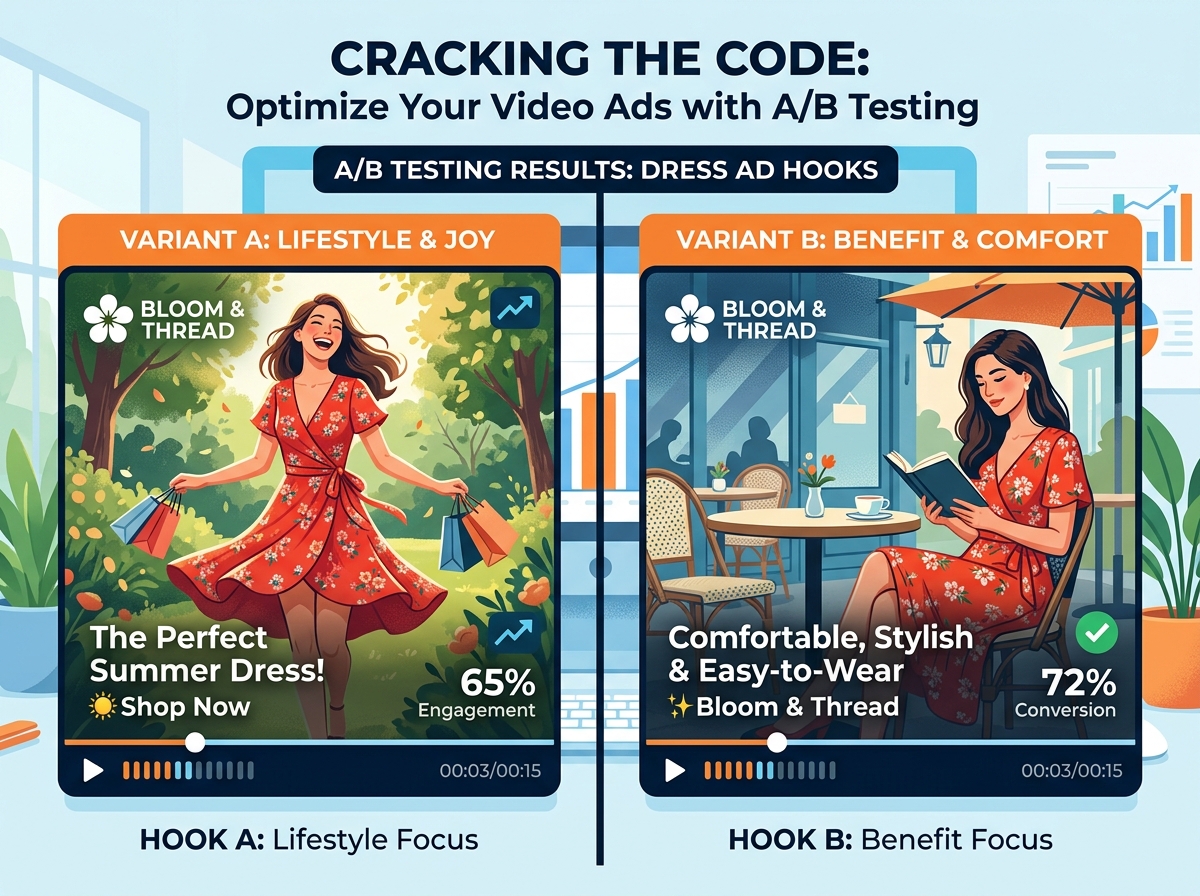
How do you set up an effective testing strategy for ad hooks?
Effective testing requires a disciplined, scientific approach. The goal is to isolate the hook as the single variable to get clean data on its impact. Testing multiple elements (hook, music, copy, CTA) simultaneously will leave you guessing what actually caused the change in performance.
A simple, effective framework follows these steps:
- Establish a Control: Start with your current best-performing ad. This is your "control" creative.
- Develop Variations: Create 2-4 new variations of this ad where the only change is the first 3-5 seconds (the hook). The body of the ad, the call-to-action, the music, and the ad copy should all remain identical to the control.
- Isolate in Your Campaign: The best practice is to test these creatives within a dedicated ad set or a Meta Advantage+ Shopping Campaign (ASC) where the algorithm can efficiently allocate budget to the top performer. Avoid testing in a campaign with dozens of other, completely different ads.
- Set a Clear Budget and Timeline: Allocate enough budget to give each variation a fair chance to gather data. A typical testing period might last 4-7 days, or until each ad has reached a statistically significant number of impressions.
Pinpointing Metrics that Truly Measure Hook Performance
Vanity metrics like views or likes won't tell you if a hook is driving business results. To measure a hook's effectiveness, focus on leading indicators of profitability and engagement that happen early in the user journey.
| Metric | What It Measures | Why It Matters for Hooks |
|---|---|---|
| Hook Rate (3s Views / Impressions) | The percentage of people who saw the ad and watched at least the first 3 seconds. | This is the purest measure of a hook's ability to stop the scroll. A high hook rate means the opening is compelling. |
| Hold Rate (ThruPlays / 3s Views) | Of the people who watched the hook, the percentage who went on to watch at least 15 seconds. | This shows if the hook effectively transitioned attention to the main ad content. |
| Outbound Click-Through Rate (CTR) | The percentage of people who clicked the link to your website. | A strong hook primes the viewer for the solution, leading to a higher intent to click and learn more. |
| Cost Per Outbound Click | The cost associated with each click to your website. | A lower CPC is often a direct result of higher engagement driven by a compelling hook. |

Optimizing and Scaling Your Best-Performing Hooks for ROAS
Once your testing framework identifies a winning hook, the work isn't over. That winner is a template for future creative development and a key to scaling your ad spend profitably.
First, direct a larger portion of your budget to the ad with the winning hook. As you scale, monitor frequency to avoid creative fatigue. A hook that works brilliantly for a week can become stale if the same audience sees it too many times. According to Meta for Business, keeping creative fresh is essential for maintaining performance over time.
Second, analyze why the winning hook performed well. Did it feature a specific problem? A particular visual style? A certain creator? Use these insights to build a "hook library" of proven concepts. When it's time to develop new creative, you're not starting from scratch; you're iterating on what you already know works, dramatically increasing your probability of success and creating a sustainable system for creative excellence.
Unlocking Creative Insights with EngageReel
This entire process of testing, measuring, and iterating on creative elements is what the EngageReel platform is built to automate. EngageReel connects creative performance data directly to the assets themselves, identifying which hooks, models, and styles are driving ROAS. It then helps your team generate new, on-brand variations based on those winning patterns, turning creative optimization from a manual guesswork process into a data-driven engine for growth. Learn more at EngageReel.com.
Frequently asked questions
What is a good hook rate for fashion ads?
While benchmarks vary by platform and audience, many performance marketers aim for a hook rate of 25-30% or higher on Meta platforms for fashion and beauty ads. Anything below 20% often suggests the hook is not effectively capturing initial attention and may need to be revised or replaced.
How do I know if my ad hook is working?
Look at leading indicators beyond simple view counts. A working hook will have a strong hook rate (3-second views / impressions) and a healthy hold rate (viewers continuing to watch). Ultimately, its success is measured by its ability to drive efficient outbound clicks and, most importantly, a profitable ROAS.
Can a bad hook ruin an otherwise good ad?
Absolutely. The most compelling offer, beautiful visuals, and perfect call-to-action are worthless if no one sees them. In a fast-scrolling feed, the hook is the gatekeeper. A weak hook ensures the rest of your ad investment is wasted because the audience has already moved on.
Should I test hooks separately from the rest of the ad creative?
Yes. This is the core principle of effective creative testing. To truly understand what works, you must isolate variables. Test different hooks against the same ad body, music, and copy. This allows you to attribute performance changes directly to the hook itself, providing clear, actionable insights.
What makes a good ad hook for fashion brands?
A good fashion ad hook is visually arresting, emotionally resonant, and immediately clear. It often combines a close-up of the product's texture or movement with a relatable problem or aspiration. Authenticity, such as user-generated content (UGC), also performs well as it feels native to social feeds.