
How to Identify Winning Creative Elements in Fashion Ads
Summary: To identify winning creative elements in fashion ads, you must isolate and tag individual components—such as the opening hook, model styling, background scene, and CTA—then correlate them directly to ROAS and CPA data. This granular approach moves you beyond knowing which ad won to understanding why it won, allowing you to systematically generate new assets that fight creative fatigue without guessing.
Fashion performance marketers often know exactly which campaigns are driving revenue, but they struggle to pinpoint the specific creative elements responsible for that success. When you cannot identify winning creative elements in fashion ads, your creative production relies on guesswork, making it incredibly difficult to launch new, high-performing assets once your primary campaigns experience creative fatigue. Solving this requires breaking down your top ads into measurable parts—hooks, scenes, models, and messaging—and attaching real performance data to each one.
EngageReel is an ad-performance platform built specifically for fashion ecommerce that handles this process automatically. The platform's Ad Engine manages live spend across Meta, Google, and TikTok to continuously optimize bids and budgets, while its Content Engine identifies exactly which hooks and lifestyle scenes are converting. By tagging each asset attribute to ROAS and CPA, EngageReel lets marketers take the exact elements that work and instantly generate the next iteration of creative, keeping campaigns profitable and fresh.
Why understanding granular creative elements matters for ROAS
When a fashion ad works, it is rarely the entire video that makes it successful; it is usually a specific combination of elements that caught the user's attention. If your team only looks at the overall ROAS of a single video, you miss the nuances of why the audience converted. Understanding these granular creative elements matters for ROAS because it shifts your strategy from blindly testing entirely new concepts to systematically iterating on proven winners.
Without granular analysis, marketers often throw away effective hooks just because the back-half of the video failed, or they duplicate a winning ad's background while completely changing the pacing that made it work. Creative fatigue happens quickly on platforms like Meta and TikTok. When you know exactly which elements drive efficiency, you can remix those specific components into dozens of new creatives, extending the lifespan of your winning angles and stabilizing your overall ad account performance.
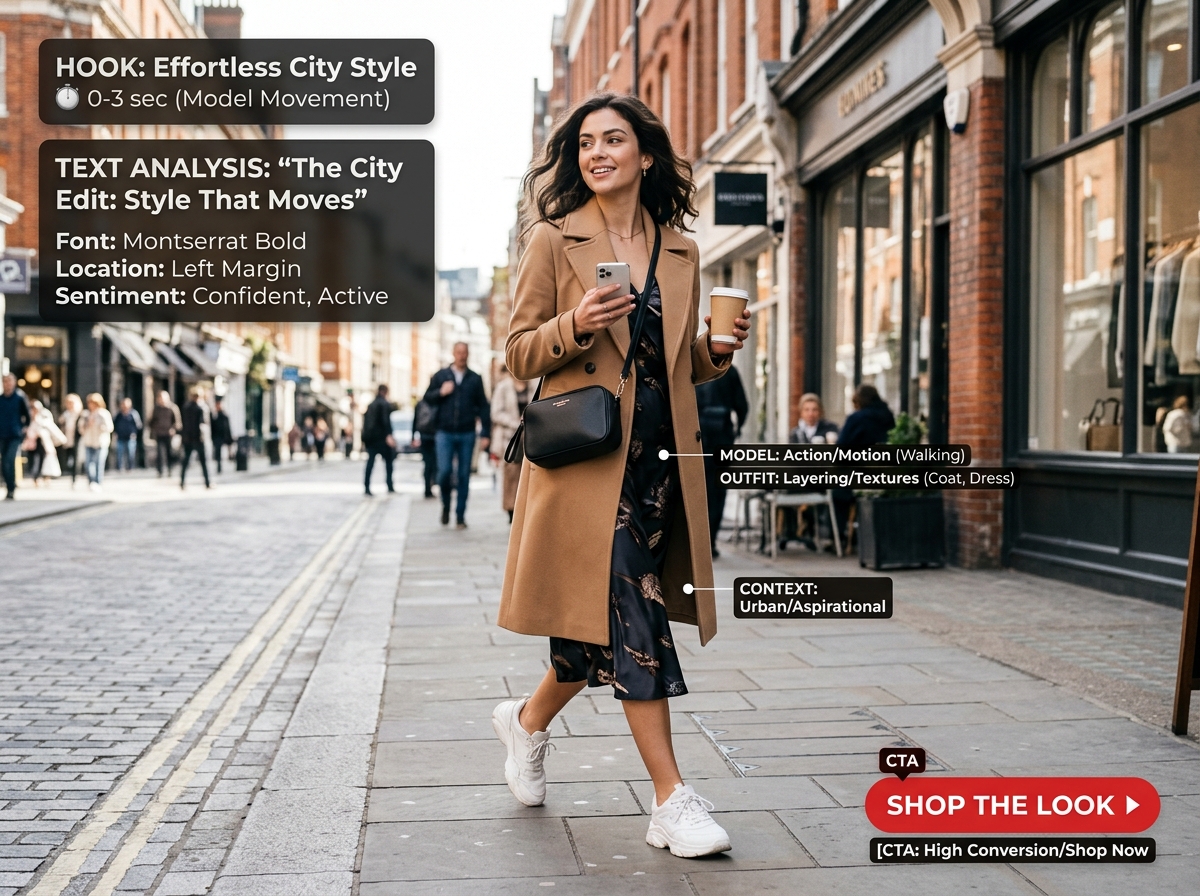
Breaking down a winning fashion ad: visual and textual components
To identify winning creative elements in fashion ads, you have to deconstruct the creative into its fundamental building blocks. This means separating the visual presentation from the pacing and the textual messaging. For fashion ecommerce, the visual components are the most immediate driver of the click. This includes the model's styling, the environment or lifestyle scene, the garment's movement, and the camera angles used in the first three seconds.
The textual and structural components support that initial hook. These elements include the on-screen text overlays, the specific offer or pricing callout, the pacing of the cuts, and the final call to action (CTA).
- The Hook: The visual or textual grab in the first 1-3 seconds (e.g., product in motion, quick outfit transition).
- The Scene: The background environment, whether it is a street style setting or a clean editorial backdrop.
- The Subject: The model's aesthetic and how the garment is styled.
- The CTA: The exact phrasing used to drive the user to the product detail page (PDP).
Data-driven methods to attribute performance to specific creative elements
Attributing performance to individual elements requires moving beyond the standard metrics provided by ad network dashboards. The most effective method is structured creative tagging. By applying metadata tags to every ad you launch—labeling the hook type, the background color, the model, and the offer—you can aggregate performance data across multiple ads to see which tags consistently yield the highest ROAS and lowest CPA.
Another data-driven method involves systematic modular testing. Instead of testing two completely different videos, you test five variations of the exact same video, changing only the first three seconds.
- Standardize your creative naming conventions to include element tags.
- Run isolated tests where only one variable (like the text overlay) changes.
- Aggregate spend and conversion data by tag, not just by ad ID.
- Identify which specific tags are present in your top 10% of performing ads.

Leveraging identified winning elements to generate new, high-performing ads
Once you know exactly what is working, the next step is applying those insights to your production pipeline. Leveraging identified winning elements to generate new, high-performing ads means your creative team no longer starts from a blank slate. If the data shows that street-style scenes with quick zoom hooks drive the lowest CPA, every new brief should incorporate those exact parameters.
This approach allows you to combat creative fatigue efficiently. When a winning ad starts to decline in performance, you do not need to invent a new concept. Instead, you keep the winning hook and swap the product, or you keep the winning product and scene but test a new text overlay. This iterative generation keeps fresh creative flowing into your ad accounts with a much higher probability of success, drastically reducing wasted ad spend on unproven concepts.
The role of AI in scaling creative element analysis and generation
Manually tagging and analyzing every frame of every fashion ad is incredibly time-consuming and prone to human error, which is where artificial intelligence becomes critical. The role of AI in scaling creative element analysis and generation is to automate the discovery of patterns that human marketers might miss. AI systems can automatically ingest hundreds of live ads, use computer vision to tag the visual elements, and correlate those tags directly with the live performance data from Meta or TikTok.
Beyond analysis, AI platforms like EngageReel's Content Engine can actively generate new creatives based on those insights. By taking the patterns that are already converting, AI can generate prompt-based edits—changing the background scene, swapping a model, or altering the styling—all while maintaining brand consistency. This creates a closed loop where ad performance dictates the next generation of creative assets, allowing performance marketers to scale their campaigns without hitting a creative bottleneck.

Frequently asked questions
What are the most important creative elements to analyze in a fashion ad?
The most important elements to analyze are the first three seconds (the hook), the product presentation (styling and movement), the background scene, and the on-screen text or offer. These components have the largest impact on whether a user stops scrolling and clicks through to the site.
How can I tell which part of my ad is actually driving conversions?
You can tell which part is driving conversions by using structured tagging and modular testing. By running variations of an ad where only one element changes, and aggregating performance data by those specific tags, you isolate the impact of individual components on ROAS and CPA.
Is it better to test full ads or individual creative elements?
It is better to test individual creative elements because testing entirely different ads introduces too many variables, leaving you guessing why one won and the other lost. Testing specific elements allows you to find repeatable patterns that you can apply to future campaigns.