
Google Ads vs Facebook Ads: Which Is Better for Your Business in 2026?
Both platforms are powerful growth engines, but they operate on fundamentally different principles. This guide clarifies how to choose the right one for your business and when it's time to use both.
- The Core Difference: User Intent vs. Discovery
- Google Ads & Facebook Ads: A Head-to-Head Comparison
- When to Prioritize Google Ads
- How to Prioritize Facebook Ads
- Comparing Costs: Clicks vs. Conversions
- A Simple Framework for Your First Move
- Why the Ultimate Strategy Involves Both
The debate between Google Ads and Facebook Ads is a constant in marketing circles. For founders, marketers, and agencies alike, the question of where to allocate budget first is critical. The right answer hinges on a single, crucial factor: how your customers discover you. Understanding this changes the game from a guess to a strategy.
In short: Google Ads excels at capturing existing demand—it connects you with users actively searching for your solution. Facebook (Meta) Ads specializes in creating new demand, introducing your products to audiences who weren't looking but are likely to be interested. Most successful brands leverage a combination, using Meta to build awareness and Google to convert intent. This is a well-established strategy, as noted by industry experts (Neil Patel).
What is the Core Difference: User Intent vs. Discovery?
Think of it as "pull" versus "push" marketing.
Google Ads is pull marketing. It responds to a direct query. When a user types "emergency plumber in Brooklyn" or "buy vegan running shoes," your ad serves an immediate, existing need. You are pulling in customers who have already raised their hands.
Facebook (Meta) Ads is push marketing. It interrupts a user's social scrolling. People are browsing their feeds, not actively shopping. A compelling ad pushes a new idea or product in front of them, sparking a desire they didn't know they had. You are creating the demand from scratch.
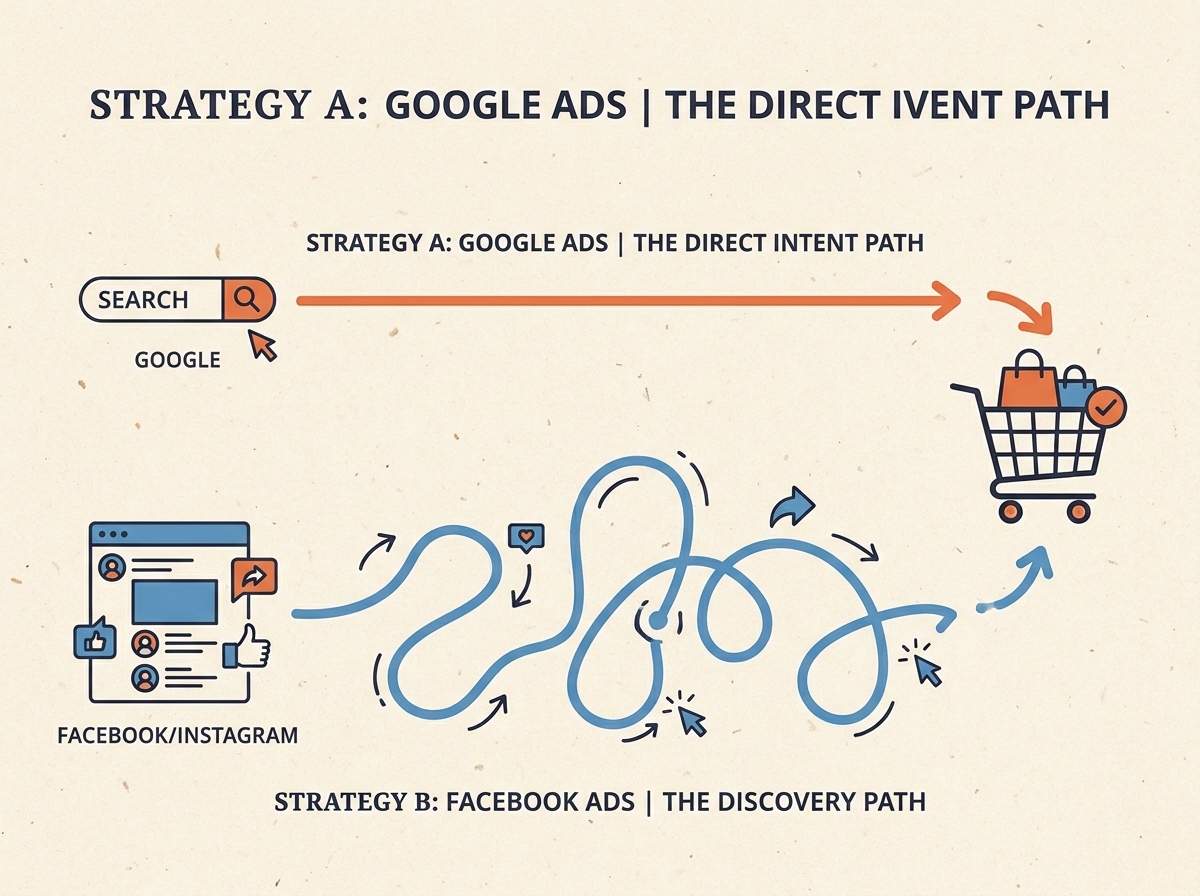
How do Google Ads and Facebook Ads Compare Head-to-Head?
| Factor | Google Ads | Facebook / Meta Ads |
|---|---|---|
| Customer Journey | They search for a solution. | Your ad finds them in their feed. |
| Buying Intent | High; often ready to purchase. | Low to medium; requires persuasion. |
| Primary Cost Model | Pay-Per-Click (PPC) | Pay-Per-Impression (CPM), optimized for your goal. |
| Targeting Methods | Keywords, search topics, location, specific demographics. | Advantage+ audiences, interests, lookalikes, behaviors, location. |
| Creative Focus | Primarily text-based, with assets for PMax, Display, and YouTube. | Visuals are paramount; images and videos drive performance. |
| Scalability | Capped by search volume. | Extremely high; vast user base on Facebook and Instagram. |
| Best For | Services, urgent needs, established product categories, capturing brand demand. | D2C, new products, visual/impulse purchases, building brand awareness. |
When Should You Prioritize Google Ads?
Google Ads is your strongest bet when your customers know what they're looking for.
You Capitalize on Existing Search Demand
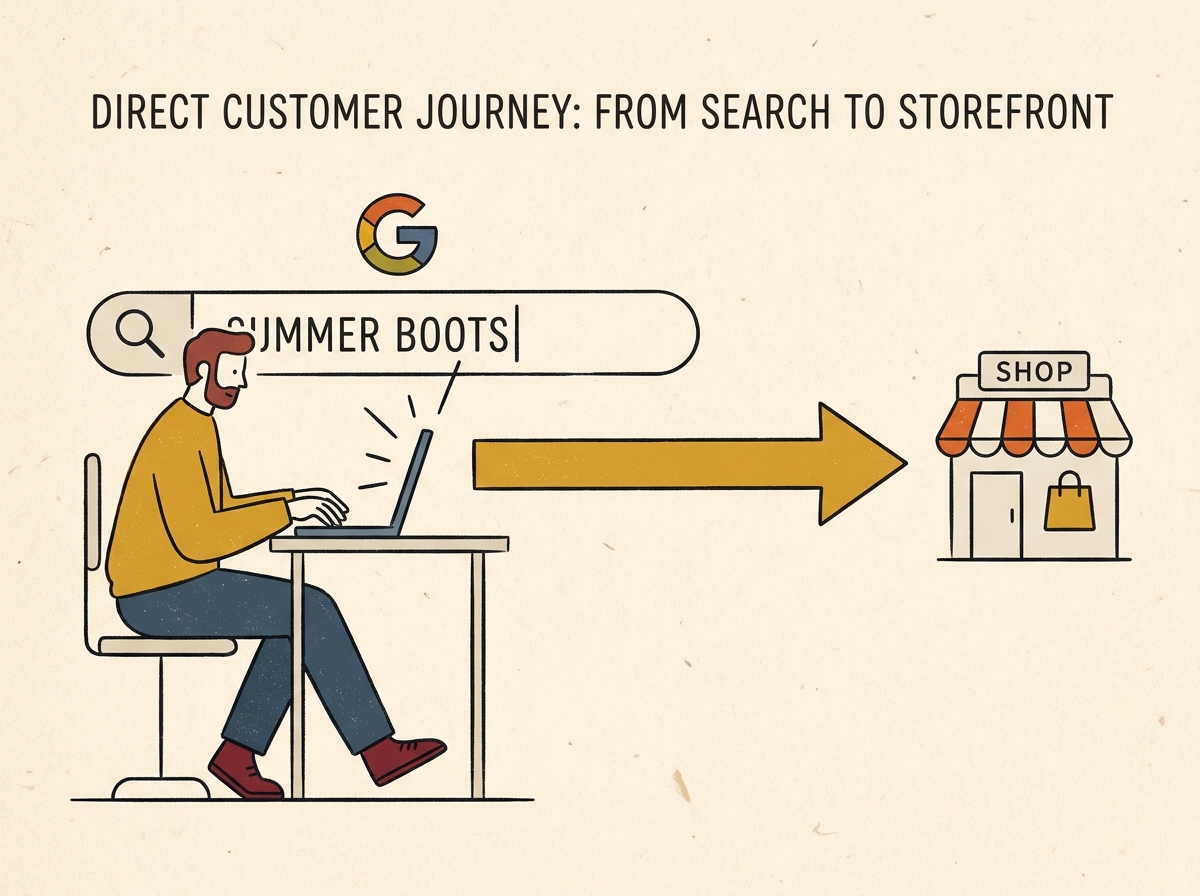
If your potential customers are actively searching for terms like "ethical wedding rings" or "accountant for small business," Google Search ads put you directly in their path at the moment of highest intent.
Your Business Serves Urgent or Local Needs
For services where timeliness is key—think clinics, repair technicians, legal aid, or local professional services—Google Search is unparalleled. It connects you with customers who need a solution right now.
You Compete in a Well-Defined Category
For e-commerce brands in established markets, Google Shopping and Performance Max campaigns (PMax) are essential. They use your product feed to capture users who are actively comparing options and prices.
Why is it Better to Prioritize Facebook Ads?
Facebook (Meta) Ads shines when you need to introduce your product to the world.
Your Product Generates Its Own Demand
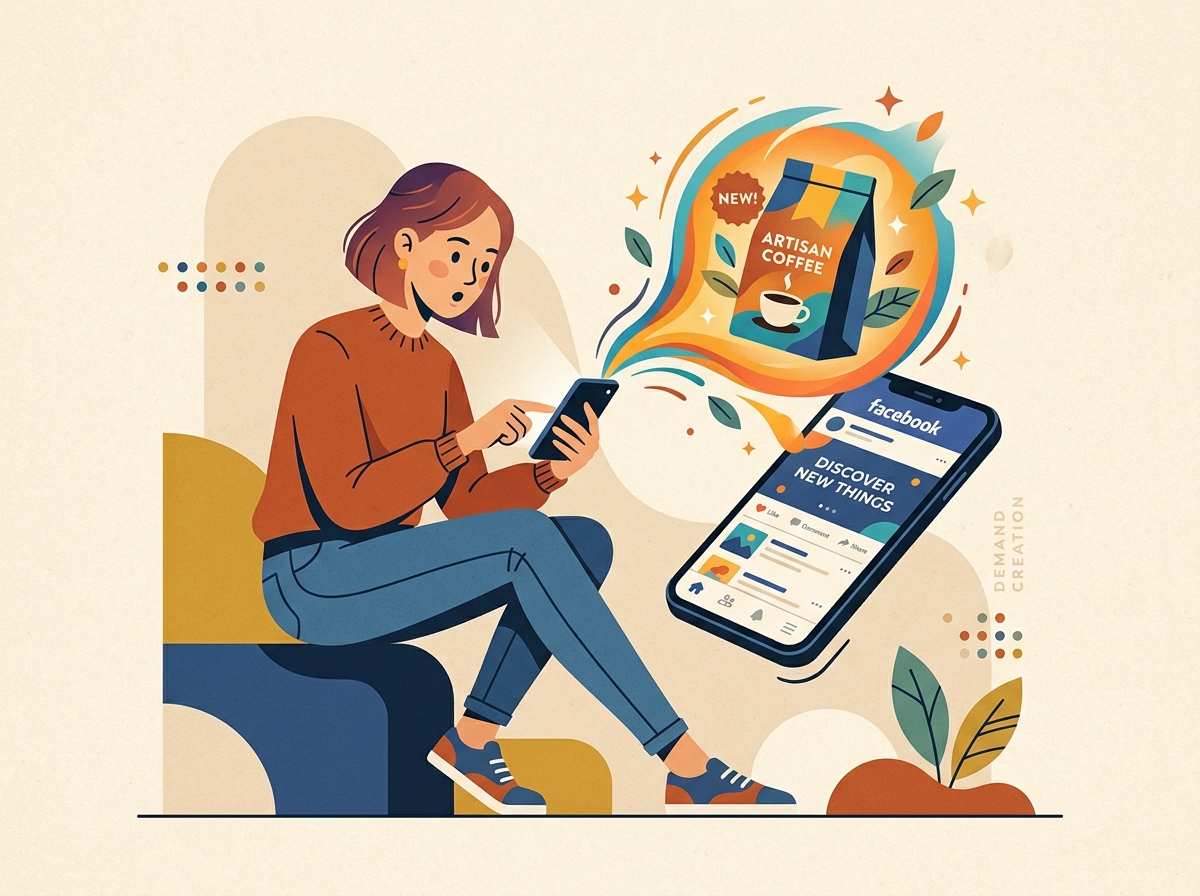
Innovative gadgets, unique fashion items, home decor, and new D2C concepts often succeed through discovery, not search. Someone sees it, loves it, and buys it. The Meta ecosystem is engineered for this kind of impulse purchasing.
Your Brand Has a Strong Visual Story
If you can showcase your product's value through compelling visuals—before-and-after transformations, unboxing experiences, user-generated content, or a powerful founder narrative—then video and image ads on Instagram and Facebook are your ideal medium.
You Need to Scale Beyond Search Limits
The number of people searching for your product on Google is finite. To grow beyond that cap, you need to reach a broader audience. Meta's vast user base provides the scale necessary for brands aiming for exponential growth. For more on this, see this analysis from WordStream.
Which Platform Offers a Better ROI?
While Facebook clicks are often cheaper than Google Search clicks, this metric can be misleading. A low-cost click from a passive scroller may not be as valuable as a higher-cost click from a motivated searcher. The only metric that truly matters is your cost per acquisition (CPA) or cost per lead.
Golden Rule: Never judge a platform by its cost-per-click. Evaluate its performance based on how much it costs to acquire a customer and the lifetime value that customer brings.
Could You Use a Simple Framework for Your First Move?
To decide where to invest first, answer these three questions:
- Is there existing search demand? Use tools like Google Keyword Planner or just observe Google's autocomplete suggestions. If people are actively searching for what you offer, start with Google Ads.
- Can you demonstrate your product's value in a short video? If your product is visually appealing and its benefits can be shown quickly, start with Meta Ads.
- What is your budget? With a modest budget (e.g., under $10,000/month), focus on mastering one platform first while dedicating 20-30% to testing the other. For larger budgets, a scaled, dual-platform strategy is essential.
Example Budget Allocations for Growing Brands
| Business Type | Recommended Starting Split (on a $10k/month budget) |
|---|---|
| Multi-location dental practice | 70% Google Search ($7,000) / 30% Meta lead generation ($3,000) |
| D2C Skincare Brand | 70% Meta Ads ($7,000) / 30% Google brand search & Shopping ($3,000) |
| Online Coaching Program | 50% Google Search ($5,000) / 50% Meta Ads ($5,000) |
| B2B SaaS | 60% Google Search ($6,000) / 40% Meta for retargeting and lead forms ($4,000) |
Should the Ultimate Strategy Involve Both?
The most effective marketing strategies recognize that Google and Meta are not competitors but collaborators in the customer journey. A user might discover your brand through an Instagram Story, forget about it, and then search for your brand name on Google a week later before making a purchase. Running ads on both platforms ensures you are present at both critical stages.
A typical integrated structure looks like this:
- Meta Ads: Run prospecting campaigns to introduce your brand to new, relevant audiences and retargeting campaigns to re-engage website visitors.
- Google Ads: Capture high-intent users with a brand search campaign, target specific keywords, and leverage Shopping or Performance Max to convert product-aware buyers.
The key is to remain agile. Review performance every few weeks and shift your budget toward the platform delivering the most efficient results against your target CPA.
Frequently asked questions
Which is cheaper, Google Ads or Facebook Ads?
Facebook Ads generally offer a lower cost-per-click (CPC) and cost-per-impression (CPM). However, Google Ads often deliver higher-intent traffic, which can lead to a lower cost-per-sale. Always compare the platforms based on your cost per acquisition, not just click costs.
Which is better for local and multi-location businesses?
For service-based businesses that people actively search for (like doctors, plumbers, or consultants), Google Ads is typically the best starting point for generating high-quality leads. Meta Ads can complement this by building local brand awareness.
Which is better for e-commerce?
Most direct-to-consumer (D2C) brands find that Meta Ads provide the greatest potential for scale by creating demand for new and visually-driven products. Google Shopping and Search are crucial for capturing that demand once a customer starts looking for your brand or category.
Can I effectively run both platforms with a $10,000/month budget?
Yes. Start with a focused strategy: one primary campaign on each platform optimized for conversions. After 2-3 weeks, analyze your cost-per-sale and allocate a larger portion of your budget to the more efficient platform while continuing to test the other.
Are Instagram ads managed separately from Facebook Ads?
No, Instagram ads are managed through the same platform, Meta Ads Manager. You can choose to run a single campaign across both Facebook and Instagram, letting Meta's algorithm optimize placements for the best results.