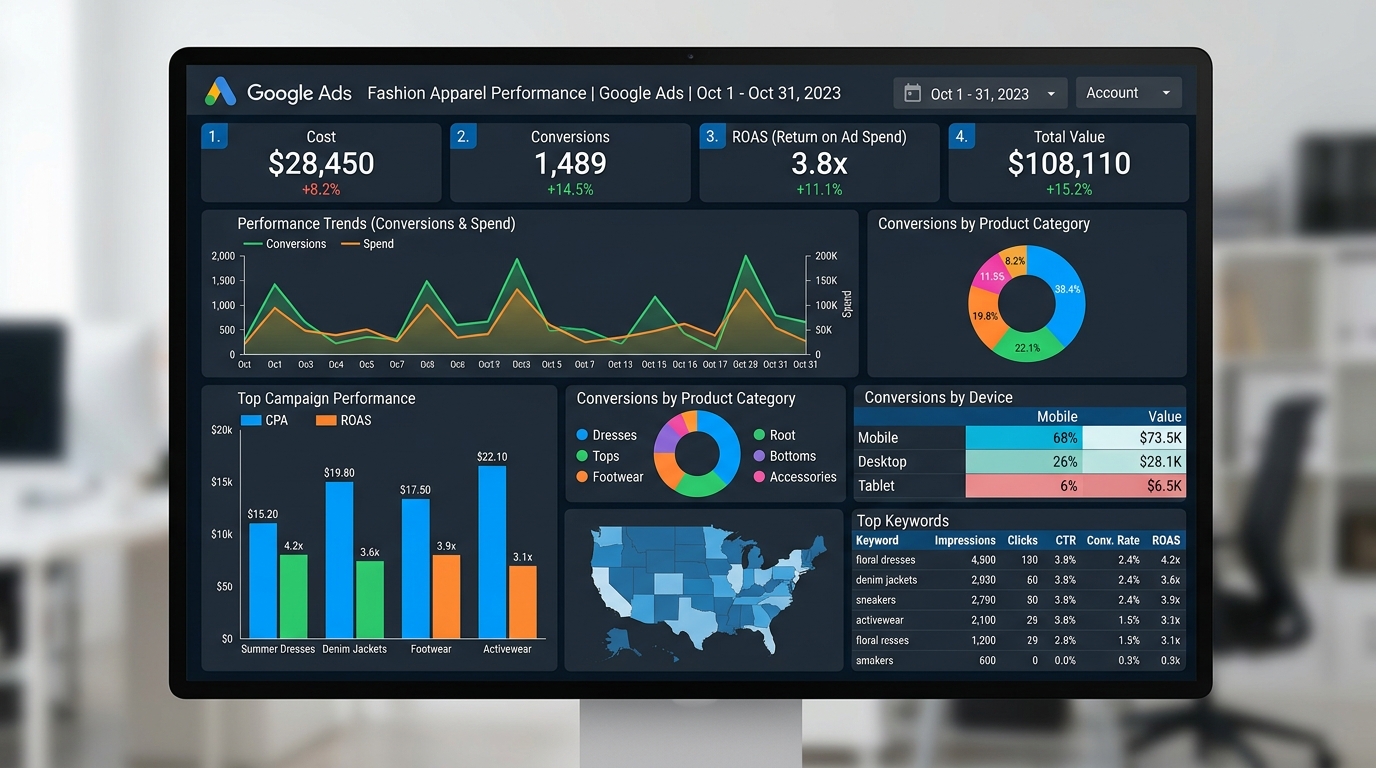
How to Advertise on Google Ads for Fashion E-commerce
To successfully advertise on Google ads, fashion e-commerce brands must deploy a full-funnel strategy spanning Performance Max, Search, and Shopping campaigns. The most efficient approach involves structuring campaigns by product category, using automated bidding strategies mapped to target ROAS, and continually refreshing creative assets. An effective setup directly influences your ability to scale revenue while lowering customer acquisition costs in a competitive market.
Fashion brands navigating modern search landscapes face fierce competition. In 2026, leveraging Google ads for business requires more than just manual keyword bidding. The introduction of advanced machine learning means that a brand's AI ad performance and creative for fashion eCommerce dictates the difference between stagnant returns and exponential growth. Advertisers must shift from manual bid adjustments to feeding the algorithm high-quality data and diverse creative assets.
This comprehensive guide details the exact steps to launch, optimize, and scale campaigns. Whether you are scaling internationally or using google ads for local business storefronts, the core principles of account structure and data hygiene remain identical. We will cover keyword structuring, budget pacing, the role of automated agents, and how to track the right metrics.
Understanding the ecosystem is paramount. Every time a consumer searches for a specific apparel item, an auction occurs in milliseconds. Your ad's rank depends on your bid, ad relevance, and expected click-through rate. Mastering these components ensures your products appear at the top of the search engine results page (SERP) when high-intent shoppers are ready to buy.
A major shift in recent years is the transition toward automation. The most successful advertisers utilize a google ads agent to manage thousands of bid adjustments simultaneously. This allows human operators to focus on broader strategic initiatives, such as creative testing and inventory management, rather than getting bogged down in microscopic bid changes.
How to Structure Your Account for E-commerce
Structuring your account properly is the foundation of long-term success. A logically organized account isolates variables, allowing you to accurately measure which product lines drive the highest ROAS and scale budgets accordingly.
Begin by dividing your campaigns by product category (e.g., Dresses, Outerwear, Accessories). Within each campaign, group your ad groups tightly around specific themes or search intents. This granular approach ensures that the ad copy directly matches the user's search query, maximizing relevance and Quality Score.
Implement a naming convention that immediately conveys the campaign's purpose, target audience, and geographic region. Consistent naming allows for rapid filtering and reporting. For example, "Search_US_NonBrand_Dresses_Broad" immediately tells you everything you need to know about that campaign.
For brands with physical stores, integrating campaigns tailored for google ads for local business ensures that local inventory is highlighted to nearby shoppers. Use location extensions and local inventory ads to bridge the gap between online search and offline purchasing.
Maintain a clear separation between Brand and Non-Brand campaigns. Brand campaigns capture users already familiar with your company, typically yielding high conversion rates and low CPCs. Non-Brand campaigns focus on generic apparel terms, driving top-of-funnel acquisition. Mixing these within the same campaign skews performance data and misallocates budget.
Regularly review your search terms report to identify irrelevant queries. Add these as negative keywords at the campaign or account level to prevent wasted spend. A robust negative keyword list is just as important as your target keyword list in maintaining high account efficiency.
Step-by-Step Campaign Setup for Fashion Brands
Setting up your first campaign requires careful attention to detail. Every setting chosen during the initial launch impacts how the machine learning algorithms will distribute your budget and target users.
- Link your Merchant Center account to your Google Ads account to sync product feeds.
- Configure conversion tracking with data-driven attribution for accurate revenue reporting.
- Select your campaign objective as Sales to prioritize high-intent users.
- Upload diverse creative assets including images, videos, and robust ad copy variants.
- Set an initial bidding strategy of Maximize Conversions before transitioning to Target ROAS.
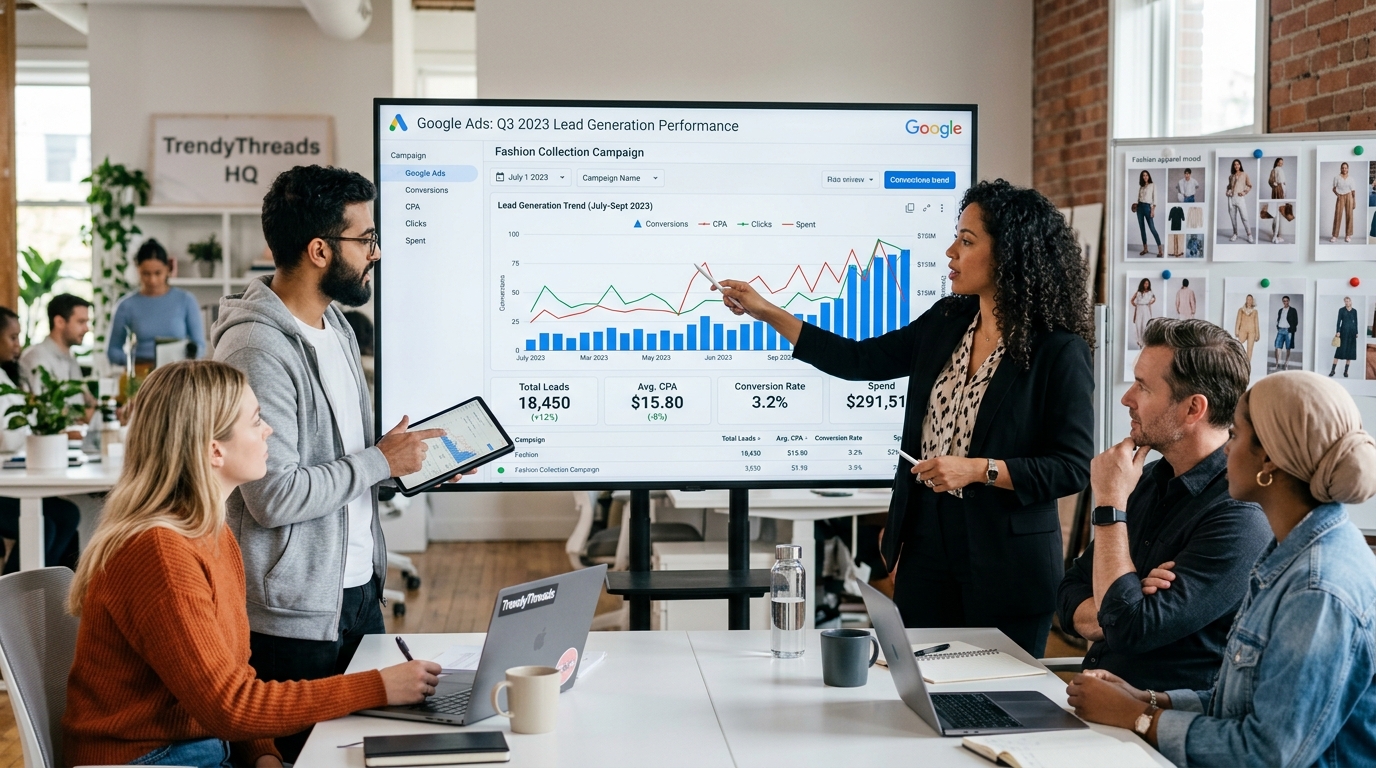
Select your campaign objective. For fashion e-commerce, "Sales" is typically the correct choice. If your goal includes wholesale inquiries or B2B connections, configure a separate campaign utilizing google ads for lead generation to capture contact information through lead form extensions.
Choose your bidding strategy based on your historical data. If you have a brand new account, start with "Maximize Clicks" to gather traffic and conversion data. Once you have accumulated at least 30 conversions in the past 30 days, transition to "Target ROAS" (Return on Ad Spend) to let the algorithm optimize for revenue.
Craft compelling ad copy. Write multiple headlines and descriptions that highlight your unique selling propositions, such as free shipping, sustainable materials, or exclusive designs. Utilize all available ad extensions, including sitelinks, callouts, and structured snippets, to maximize your real estate on the SERP.
Finally, set up comprehensive conversion tracking. Install the global site tag and ensure that purchase events, add-to-cart events, and lead form submissions are accurately recorded. Without pristine conversion data, automated bidding strategies cannot function effectively.
Best Practices for Writing High-Converting Ad Copy
Writing effective ad copy is an exercise in balancing algorithmic requirements with human psychology. Your text must satisfy relevance checks while simultaneously persuading a shopper to click your link over a competitor's.
Always include the target keyword in the first headline. This immediately signals to the user that your ad is highly relevant to their search query. Follow this with a strong benefit or offer in the second headline, such as "20% Off Your First Order" or "New Summer Collection."
Use dynamic keyword insertion (DKI) sparingly. While DKI can increase relevance by automatically inserting the user's search query into your ad, it can also lead to awkward or grammatically incorrect phrasing if not carefully monitored. Always review the search terms triggering your DKI ads.
Highlight your brand's unique value proposition (UVP). Why should a customer buy from you instead of a massive fast-fashion retailer? Emphasize ethical sourcing, premium materials, or unique sizing options in your descriptions to differentiate your brand.
Incorporate a clear call to action (CTA). Tell the user exactly what you want them to do next, whether it's "Shop Now," "Discover the Collection," or "Sign Up Today." A strong CTA significantly improves click-through rates.
Continuously A/B test your ad copy. Create at least three variations of responsive search ads per ad group. Pin different headlines and descriptions to see which combinations yield the highest conversion rates. Let the data dictate your creative strategy.
How to Leverage AI and Automation in Your Campaigns
The landscape of paid search is increasingly dominated by artificial intelligence. Advertisers who resist automation will inevitably be outperformed by those who embrace it and learn to guide the algorithms effectively.
Performance Max (PMax) campaigns represent the pinnacle of Google's automation efforts. PMax serves ads across all Google channels-Search, Display, YouTube, Discover, and Gmail-from a single campaign. Success with PMax depends entirely on the quality of the assets (images, videos, text) you provide and the audience signals you input.
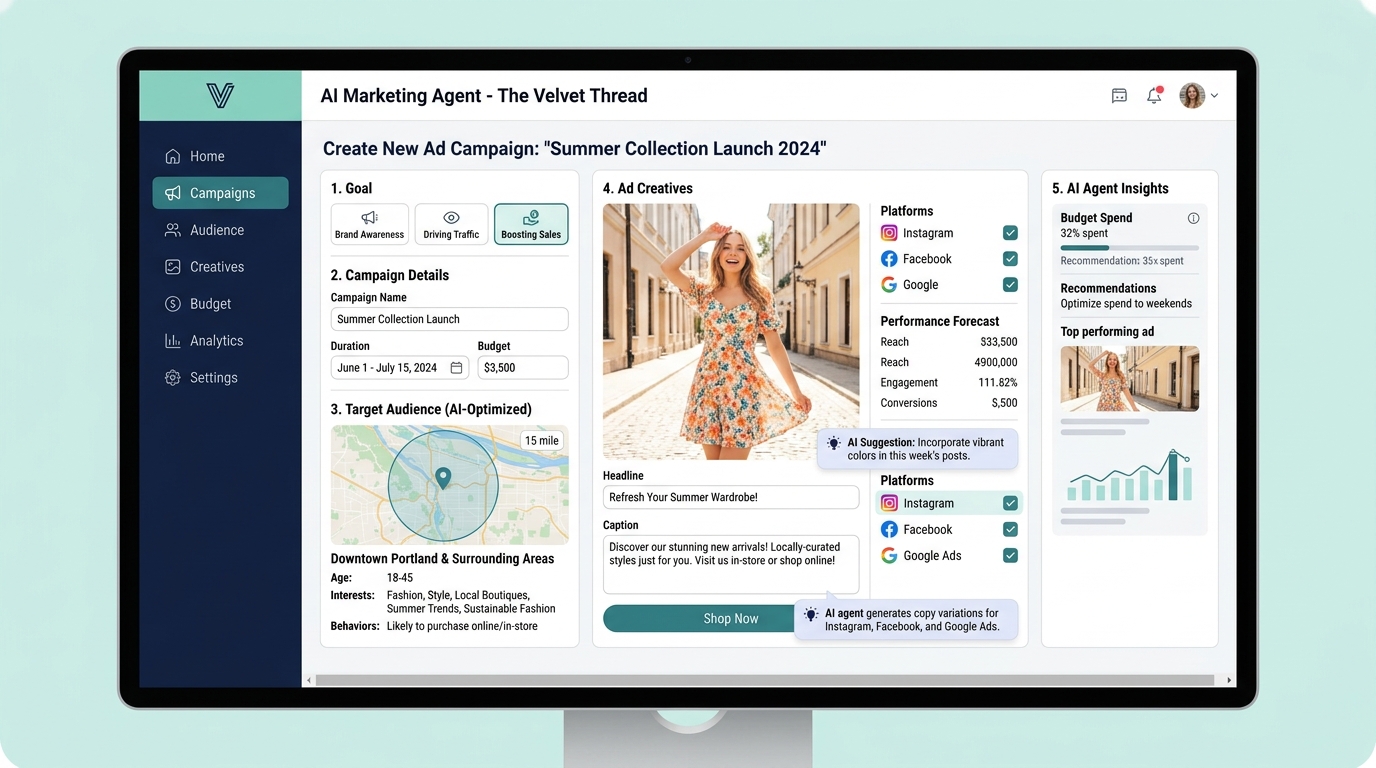
Provide robust audience signals to jumpstart machine learning. Upload your first-party customer lists, website visitors, and custom segments based on competitor URLs. This gives the algorithm a clear template of what your ideal customer looks like.
Utilize a google ads agent to manage bid optimization and budget reallocation. These tools analyze millions of data points in real-time to adjust bids based on device, time of day, location, and user intent, far surpassing human capabilities.
Adopt broad match keywords paired with Smart Bidding. In the past, broad match was considered wasteful. Today, when combined with Target ROAS bidding, broad match allows the algorithm to find high-converting search queries that you may have never considered, scaling your reach efficiently.
Consolidate your account structure. Machine learning requires data density. Instead of hundreds of hyper-segmented ad groups, create fewer, larger ad groups. This provides the algorithms with enough conversion volume to learn and optimize effectively.
Checklist for Monitoring and Scaling Performance
Scaling a campaign requires a systematic approach to performance monitoring. Scaling too quickly can reset learning phases and crash ROAS, while moving too slowly leaves revenue on the table.
Monitor your Impression Share metrics daily. Search Impression Share (IS) and Search Lost IS (Budget/Rank) tell you exactly why your ads aren't showing. If you are losing share due to budget, and your ROAS is above target, increase your budget immediately.
Review the Asset Detail report in your Performance Max campaigns. Replace assets labeled "Low" performance with new creatives. Ensure you are testing different video formats and aspect ratios to maximize inventory across YouTube and Discover.
Analyze device performance. Are mobile users converting at a lower rate than desktop users? If so, investigate your mobile site speed and checkout experience. Do not simply decrease mobile bids; fix the underlying conversion rate issue.
Evaluate your attribution model. Transition from last-click attribution to data-driven attribution (DDA). DDA assigns credit to every touchpoint in the user journey, giving you a much more accurate picture of which top-of-funnel campaigns are driving downstream sales.
Plan for seasonality. Fashion e-commerce is highly cyclical. Anticipate spikes in demand for Black Friday, holidays, and seasonal changes. Increase budgets and lower ROAS targets slightly ahead of these periods to capture early search interest and build your retargeting pools.
References
- Google Ads Benchmarks Report, September 10, 2026
Frequently asked questions
How much does it cost to advertise on Google ads?
The cost to advertise on Google ads varies based on your industry, keywords, and quality score. Fashion e-commerce brands typically see CPCs between $0.50 and $2.00, depending on the competition for specific apparel terms.
Can a google ads agent improve my ROAS?
Yes, a google ads agent uses AI algorithms and historical data to optimize bids, refine targeting, and improve ad relevance 24/7, leading to a higher return on ad spend.
Is google ads for local business effective?
Absolutely. Google ads for local business allows you to target users searching for products within a specific geographic radius, driving foot traffic and local sales.