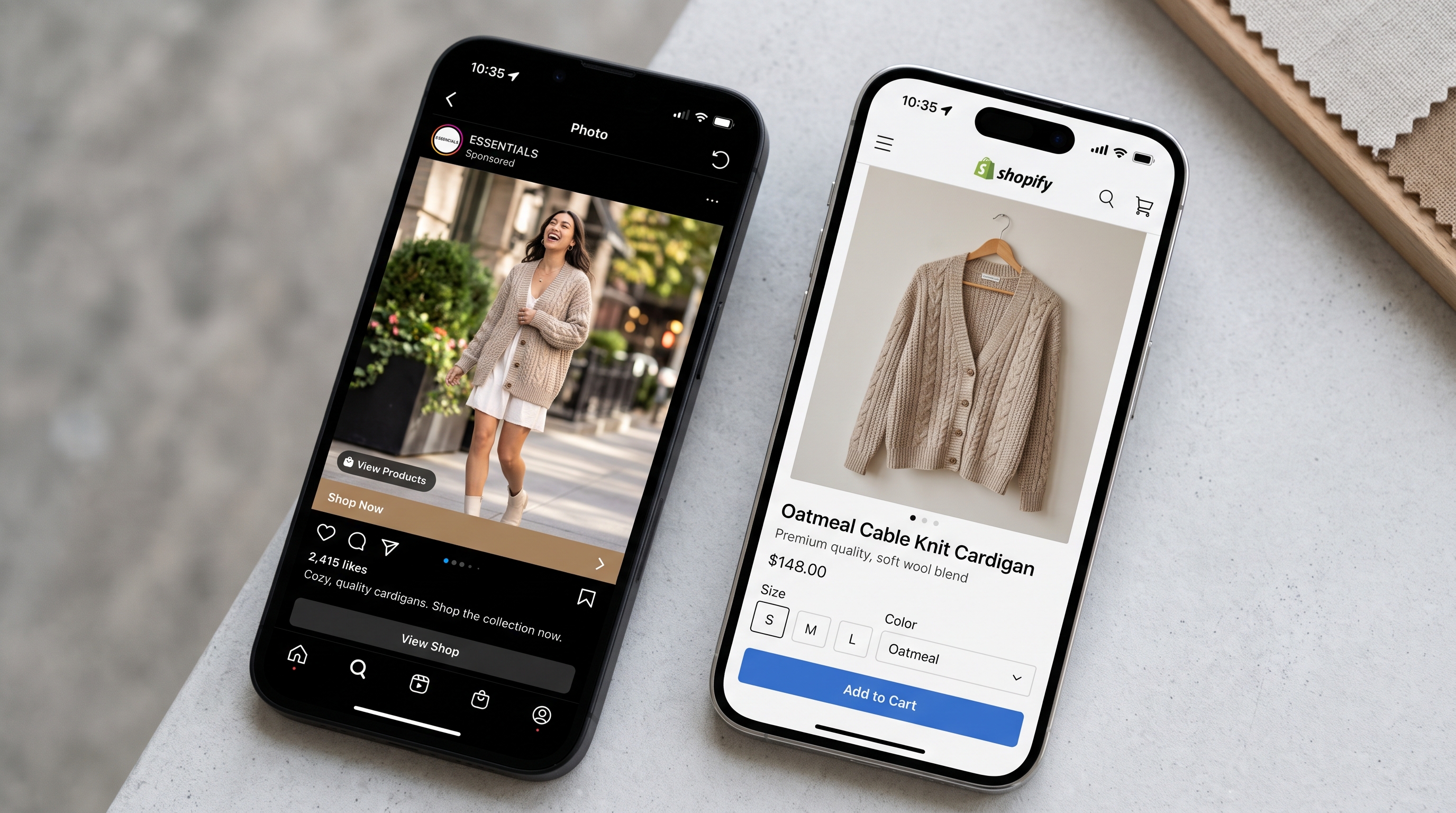
Ads Getting Clicks But No Sales? How to Fix Your Funnel

When your ad dashboard shows strong engagement and healthy click-through rates, but your Shopify dashboard shows zero sales, panic usually sets in. Performance marketers and fashion e-commerce founders waste thousands of dollars trying to solve this by tweaking ad spend or launching new hooks. But when ads getting clicks but no sales is your primary symptom, the bottleneck is almost never your ad creative—it is the violent disconnect between the promise made in the ad and the reality your visitors find on your landing page. Pouring more budget onto a leaking funnel only accelerates cash burn.
To diagnose and fix this revenue leak, media buyers must examine the exact handoff from social feeds to storefronts, ensuring that mobile site speed, visual proof, and pricing alignment support the intent generated by top-of-funnel ads.
Why your click-to-purchase ratio is the only metric that matters
Most media buyers obsess over vanity metrics: cost per click (CPC), click-through rate (CTR), and thumbstop ratio. While these indicators prove your ad hook is stopping the scroll, they tell you nothing about buyer intent. In modern fashion and beauty advertising across Meta, Google, and TikTok, high CTR with zero conversions points directly to misaligned expectation setting.
If your video ad promises a luxury unboxing experience, trend-forward styling tips, or an exclusive discount, but lands the user on a cluttered, slow-loading product description page (PDP) with generic stock photography, the visitor bounces within three seconds. Understanding why people are clicking your ads but not buying requires looking past top-of-funnel engagement and auditing the exact handoff.
How to spot if the disconnect is in your offer, your load speed, or your product page layout
Diagnosing ad funnel drop-off requires a systematic elimination of variables. When diagnosing meta ads traffic but no sales, break your post-click journey down into three distinct diagnostic pillars:
- Examine your offer consistency between the ad creative and the product page above the fold.
- Measure mobile load times and interaction readiness across iOS and Android social browsers.
- Evaluate visual and social proof elements to ensure they match or exceed the quality promised in the video.
The following comparison breaks down the symptoms and root causes of high traffic with low conversion rates:
| Funnel Symptom | Likely Root Cause | Immediate Fix |
|---|---|---|
| High CTR, 0% Add-to-Cart | Offer mismatch or missing discount code | Display promo banner matching ad promise above the fold |
| High Add-to-Cart, High Checkout Drop-off | Hidden shipping fees or slow payment gateway | Expose shipping costs upfront and streamline express checkout |
| High Bounce Rate (>70%) | Slow mobile load speed or poor visual proof | Compress hero images and replace flat lays with on-model assets |
What to change on your landing page when the ad is already working
When your ad creative is clearly driving high intent and strong click volume, altering the ad is the wrong move. Instead, treat your landing page as an extension of the ad narrative. Implement these specific conversion architecture fixes to capture eager shoppers:
Ensure your hero headline and primary product imagery instantly validate the specific hook angle that drove the click. If the user arrived via a video demonstrating garment drape and movement, the landing page must immediately feature dynamic video content rather than static ghost mannequin photos.

Addressing the misconception that more traffic solves low conversion rates
A common trap among growing D2C brands is believing that scaling ad spend will magically cure a lagging conversion rate. In reality, sending more traffic to a broken, slow, or mismatched product page only multiplies your customer acquisition cost (CAC) and burns through working capital.
Fixing the conversion rate and optimizing site UX must always precede scaling top-of-funnel spend. Once your click-to-purchase ratio stabilizes within healthy industry benchmarks, scaling media spend becomes profitable and sustainable.
Aligning your ad creative with your site experience to stop the bounce
To eliminate low conversion rate on website from ads, brand teams must build a closed-loop feedback system where creative insights inform site UX and vice versa. EngageReel's platform architecture emphasizes tagging creative assets—hooks, models, scenes, and messaging—directly to downstream conversion behavior. When a specific video hook consistently drives buyers rather than window shoppers, that exact visual narrative should dictate the hero messaging on your landing page.

Frequently asked questions
How do I know if the problem is my ad or my website?
Check your outbound CTR versus your add-to-cart and conversion rates. If your CTR is healthy (>1.5% on Meta) but your click-to-purchase conversion rate is near zero, your ad is succeeding and your website or offer is failing.
What is a good click-to-purchase conversion rate for fashion?
A healthy benchmark for e-commerce fashion stores sits between 1.5% and 3.0%, depending on traffic temperature, average order value, and brand awareness.
Should I change my ad hook or my landing page first?
Always inspect your landing page first if your CTR is strong. If visitors are clicking, your ad has already done its job; changing the ad will only disrupt your learning phase while leaving the website friction unaddressed.
How can I test landing page changes without losing my ad account's learning phase?
Use URL parameters or dedicated landing page variants linked within your existing ad sets without pausing or editing the core ads themselves, preserving campaign momentum.
Why is my landing page not converting traffic from social media?
Social traffic is impulsive and mobile-first. If your page has slow load times, unclear pricing, hidden shipping fees, or weak visual proof, users will bounce immediately.