
Creative Volume vs ROAS: What Most Fashion Brands Get Wrong

In this article
This article deconstructs the common misconception that increasing creative volume directly improves ROAS. It's for fashion performance marketers who are creating more ads but seeing stagnant or declining returns. You'll learn a data-driven framework to improve creative quality, not just quantity, and how to build a scalable system for predictable ad performance.
- Understand the root cause of creative fatigue and its financial impact.
- A 4-step process for testing and validating ad angles that actually convert.
- How to build a diverse creative stack that Meta's algorithm favors for better delivery.
- Unlock a smarter, automated approach to creative optimization with EngageReel.
Does simply producing more ad creatives lead to a higher return on ad spend (ROAS)? The short answer is no. Pouring resources into volume without a system to measure what works is a leading cause of wasted ad spend and stagnant performance. The key isn't more creatives, but more of the right creatives—a strategy that requires a shift from a production-focused mindset to a performance-driven feedback loop that informs every new asset you create.
What Creative Fatigue Actually Costs a Fashion Brand
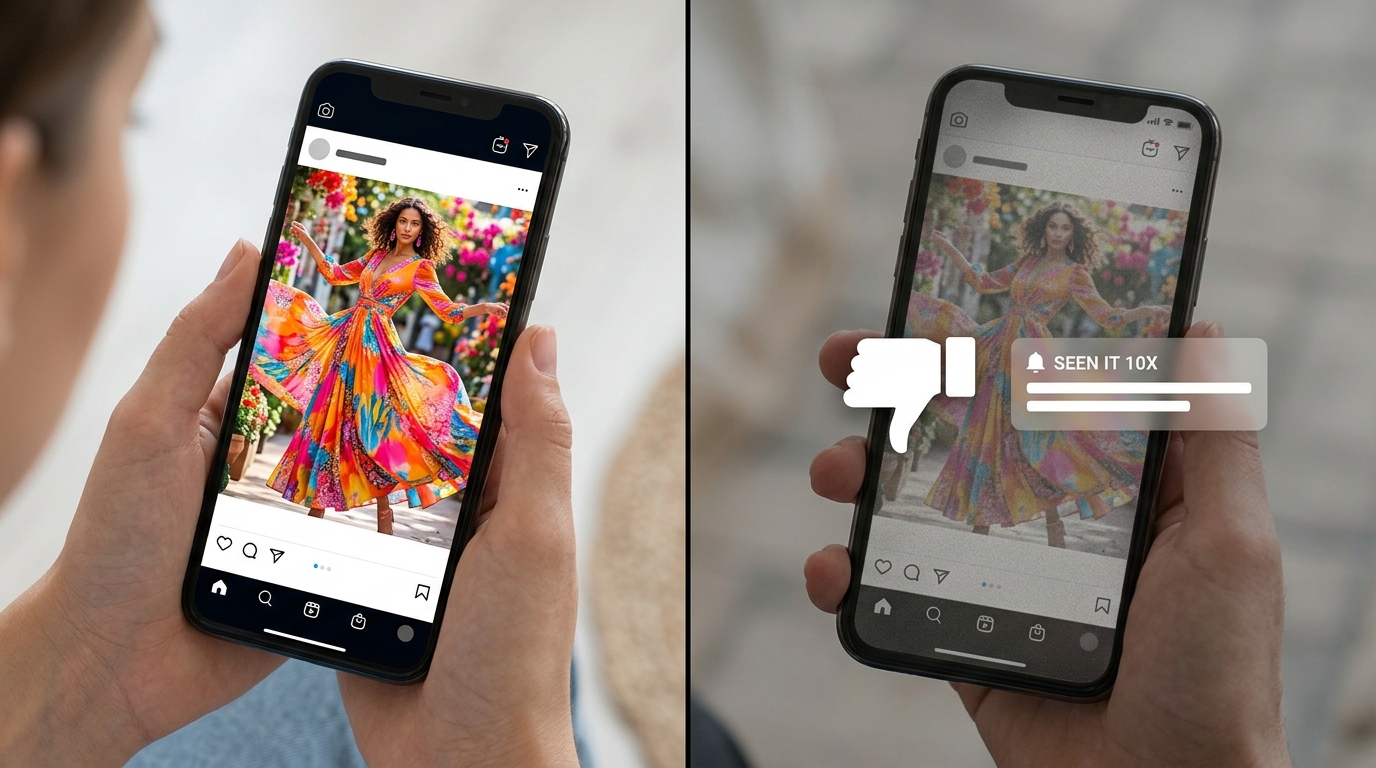
Creative fatigue happens when your audience sees the same ads too frequently, leading to banner blindness, decreased engagement, and higher costs. As platform algorithms favor a few top-performing assets, they quickly burn out their effectiveness within a target audience. According to a 2024 analysis by RevenueCat, this leads to a gradual loss of efficiency, declining CTR, and rising costs in both lower and upper funnel metrics. For a fashion brand spending $50,000/month on Meta platforms, even a modest 10% drop in ROAS from fatigue translates directly to $5,000 in lost revenue potential—or a staggering $60,000 annually. This isn't just a performance dip; it's a significant financial drain that compounds over time.
Why More Volume Often Dilutes Performance
The pressure to constantly "feed the algorithm" with new content often leads to rushed, off-brand, or repetitive creative that does more harm than good. Without a clear testing framework, you're just launching more variables into an already complex system, making it impossible to learn what truly works. Meta's own evolution towards Advantage+ campaigns underscores this reality; the system automates targeting and delivery, leaving the creative and the offer as your two primary levers for performance. As Ben Heath of Social Media Examiner notes, "No amount of campaign-level optimization can compensate for creative that fails to connect." Throwing more darts in the dark doesn't increase your odds if you're aiming at the wrong target. This is because algorithms optimize for engagement signals in the short term. If you provide a high volume of low-quality creative, the algorithm may optimize towards a sub-par audience that engages superficially (likes, shares) but doesn't convert, ultimately hurting your ROAS and training the algorithm on the wrong user behavior.
How to Discover Angles That Actually Drive Purchases?
An "angle" is the core reason a customer decides to buy. Is it the affordability, the exclusive style, the social status it confers, or its ability to solve a specific problem (like finding the perfect wedding guest dress)? The only way to know for sure is to test these angles systematically. The best place to start your research is your own customer reviews. What benefits and use-cases do your happiest customers consistently highlight? These are your most authentic and powerful starting points for testable angles. For example, a fashion brand might test an "occasion" angle (e.g., "perfect for summer weddings") against a "durability" angle (e.g., "designed to last a lifetime"). Don't limit yourself to just product features; consider emotional triggers, social proof (e.g., "as seen on..."), and problem-solving narratives as well. A powerful angle often taps into a customer's identity or aspirations, making the purchase feel like a personal statement.
| Dimension | Weak Approach | Strong Approach |
|---|---|---|
| Hypothesis | "Let's try a new video and see what happens." | "We believe a 'style versatility' angle will outperform our current 'affordability' angle for this audience, leading to a higher AOV." |
| Creative | One new video with a different model but the same message. | Three new creatives (a short video, a carousel, and a static image) all focused on the 'style versatility' angle. |
| Measurement | "Did ROAS go up or down?" | "Did the 'style versatility' creatives achieve a higher CTR, lower CPA, and better ROAS than the control group?" |
Common Pitfalls in High-Volume Creative Production
When the directive from leadership is simply "we need more creatives," several predictable issues arise that can actively degrade overall ad performance and burn budget. First is the inevitable "regression to the mean," where the average quality and strategic thought behind each creative drops as the production process is rushed to meet a quota. Second is "brand drift," a common side effect of using multiple freelancers or agencies without a strong, centralized creative brief; this results in ads that don't look, feel, or sound like the core brand, eroding trust and recognition. Finally, and perhaps most dangerously, there's "metric misinterpretation," where teams start chasing vanity metrics like video views or likes instead of the hard business metrics that drive revenue, like ROAS, Customer Lifetime Value (LTV), and Cost Per Acquisition (CPA). Avoiding these pitfalls requires a disciplined approach, a strong creative brief that is rooted in data, and a clear review process that is tied directly to performance data, not just aesthetic preferences.
A Step-by-Step Playbook for Effective Creative Testing
To move from guessing to knowing, you must implement a structured and repeatable testing process. This creates a powerful feedback loop that consistently improves your AI ad performance and creative for fashion eCommerce, ensuring your budget is allocated to concepts that are statistically proven to work. A rigorous testing methodology is the single most effective way to combat creative fatigue and systematically improve ROAS over time. It transforms your ad account from what feels like a slot machine into a predictable engine for business growth.

- Identify Your Core Angles: Based on customer reviews, competitor analysis, and market research, define 2-3 distinct angles (e.g., Style, Affordability, Exclusivity, Sustainability). Frame each as a clear, testable hypothesis: "We believe a 'sustainability' angle will resonate more with our younger, urban audience segment than our current 'affordability' messaging."
- Create Diverse Assets for Each Angle: For each angle, produce a small, diverse set of creatives—a short-form video, a static image, and a carousel ad. This allows the algorithm to match the right format to the right user on the right platform. Consistency within the angle is absolutely key; all assets should communicate the same core message and value proposition.
- Isolate Your Test: Use a dedicated testing campaign (or a single ad set within an Advantage+ campaign) with a controlled budget. Pit your new angle-specific creatives against your current top performer (the "control"). It is crucial to avoid making other changes (e.g., to audience, landing page, or offer) during the test to ensure you're isolating the impact of the creative itself.
- Analyze and Scale: After enough data has been gathered (typically 3-7 days, depending on spend), analyze not just the primary goal (ROAS), but also leading indicators like Hook Rate (first 3s view rate) and Click-Through Rate (CTR). If a new angle proves successful, move its winning creative assets into your main scaling campaigns and designate it as the new "control" to beat in your next round of testing.
Where EngageReel Automates This Entire Process
Manually running this testing playbook is a labor-intensive and data-heavy process that can quickly overwhelm a small marketing team. EngageReel is designed to automate this entire cycle. The platform continuously ingests and analyzes the performance of every single creative in your ad account, identifying the specific attributes—from backgrounds and models to CTAs and headline sentiment—that are driving conversions. It then provides clear, data-backed recommendations for your next creative brief, turning a manual, reactive process into an automated, proactive strategy. By connecting creative performance directly to business outcomes, EngageReel ensures that every new creative you produce is smarter and more effective than the last.
Key Metrics That Signal a Winning Creative
Beyond ROAS, which is a lagging indicator, you should focus on leading indicators that show a creative is resonating early and efficiently. A high Hook Rate (the percentage of users who watch the first 3 seconds of a video) shows your intro is successfully stopping the scroll in a crowded feed. A strong Hold Rate (average watch time) indicates that your message is compelling and holding attention. A high Click-Through Rate (CTR) means the ad is generating strong intent and relevance. According to Criteo (2026), a CTR above 2.5% is considered strong for fashion ads on social platforms. Tracking these metrics can help you identify winning creatives long before you've spent thousands of dollars trying to optimize them towards a final purchase.
Frequently asked questions
How do you increase ROAS with creative?
You increase ROAS not by making more creative, but by making *better* creative. This involves a systematic process of testing different angles, formats, and messages to see what resonates most effectively with your target audience. Utilizing tools that provide deep creative analytics is essential for this, as they connect specific creative choices (like a background color or a headline style) directly to performance data, removing guesswork from the optimization process.
How do you know if a creative is good?
A "good" creative is one that efficiently achieves your campaign objective. While aesthetic appeal is a factor, the ultimate measure of a creative's quality is its performance. Look at a full range of metrics: a high Click-Through Rate (CTR) indicates relevance, a low Cost Per Acquisition (CPA) indicates efficiency, and, of course, a high ROAS indicates profitability. A creative with a high CTR but low conversion rate, for example, may be getting attention but failing to attract the right, high-intent customers.
How many creatives should you test?
While some ad platforms can handle a large volume, a "more is better" approach isn't always effective. A more manageable and strategic approach, in line with [Meta's guidance](https://www.facebook.com/business/learn/lessons/drive-performance-with-advantage-creative) for Advantage+ campaigns, is to have 3-5 high-quality, diverse creatives per ad set. This ensures you have a mix of formats (e.g., video, static, carousel) to allow the algorithm to optimize delivery effectively without spreading the budget too thin.
What is the fastest way to find new creative angles?
Your existing customer reviews are a goldmine of marketing intelligence. Use a simple word cloud tool or an AI summary tool to analyze the language your happiest customers use to describe your products. The most frequently mentioned benefits or use-cases are often your strongest and most authentic marketing angles, as noted by marketing experts at Social Media Examiner.
Can changing the ad copy refresh a fatigued creative?
Yes, but it's often a short-term fix that yields diminishing returns. While refreshing headlines and body copy can provide a small, temporary bump in performance, the visual element of the ad (the image or video) carries the most weight in capturing attention. A/B testing copy is a good practice, but it's not a substitute for developing fundamentally new visual assets and concepts.
References
- RevenueCat — Why creative fatigue is killing your ROAS (2024)
- Social Media Examiner — Ad Creative Strategy: The Easy Way to Improve Facebook and Instagram ROAS (2026)
- Criteo — How to increase ROAS: 4 ways to optimize your ad spend today (2026)
- Meta for Business — Drive performance with Advantage+ creative
- HubSpot — How to Do A/B Testing: A Checklist You'll Want to Bookmark