
Why Organic TikToks Fail as Paid Ads: Creative Fixes for Fashion

This article breaks down why successful organic TikTok content often fails when repurposed as paid ads for fashion and beauty brands. It provides actionable creative frameworks for adapting your content to drive conversions and maximize return on ad spend (ROAS).
- Understand the fundamental differences between organic and paid content goals.
- Identify common pitfalls that cause organic content to underperform in paid campaigns.
- Learn a step-by-step process for adapting creative for paid ad success.
- Discover how EngageReel helps automate creative optimization for TikTok.
Ever boosted a viral organic TikTok only to see it flop as a paid ad? You're not alone. Many fashion and beauty brands assume that what captivates an organic audience will automatically convert a paid one. The reality is that the two formats serve entirely different purposes, and conflating them is a fast way to burn through your ad budget with little to show for it.
What's the real difference between organic and paid TikTok content goals?
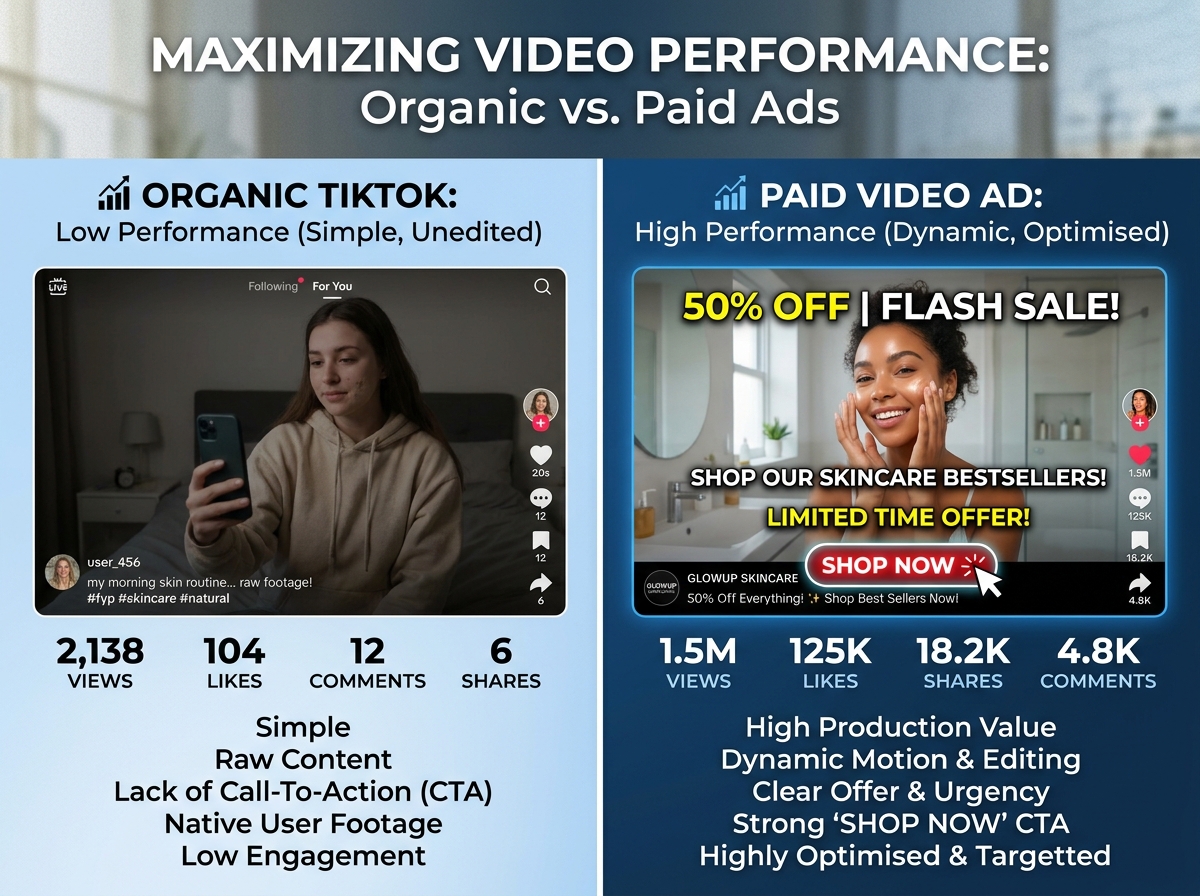
Organic content on TikTok is designed for entertainment and community building. Its primary goal is to engage your existing followers and attract new ones through algorithmic discovery on the For You Page. Success is measured in views, likes, comments, and shares—metrics that signal cultural relevance and brand affinity.
Paid content, on the other hand, is built for conversion. Its purpose is to drive a specific action, such as a website click, a product purchase, or a lead submission. According to TikTok's own documentation, successful performance ads are clear, direct, and guide the user toward a specific outcome. While organic content builds a relationship, paid content asks for a commitment.
| Factor | Organic TikTok Content | Paid TikTok Ads |
|---|---|---|
| Primary Goal | Engagement & Community Building | Conversion & Direct Response |
| Audience | Existing followers & algorithmic discovery | Targeted segments (demographics, interests, behaviors) |
| Success Metrics | Views, Likes, Shares, Comments | CTR, CVR, CPA, ROAS |
| Content Style | Entertaining, trend-focused, authentic | Problem-solution, benefit-driven, clear CTA |
Why do organic TikToks often fail to convert as paid ads?
The core reason organic content underperforms in a paid context is a misalignment of intent. A user scrolling their For You Page is in a passive entertainment mindset, while a user served a paid ad is being prompted to make a decision. Here’s why that disconnect matters:
1. Lack of a Clear Call-to-Action (CTA)
Organic videos rarely have a strong, direct CTA. They might implicitly promote a product, but their primary job isn't to sell. Paid ads need an unmissable CTA that tells the user exactly what to do next, whether it's "Shop Now," "Learn More," or "Sign Up." Without it, the user is left wondering what the point of the ad was.
2. Pacing and Structure Are Built for Browsing, Not Buying
Organic content often has a slow build-up, relying on a trend or a story to keep viewers engaged. Paid ads have a much shorter window to capture attention—typically the first 3 seconds. An effective ad needs a strong hook, a clear presentation of the problem and solution, and a compelling offer, all delivered at a rapid pace.
3. The Hook Isn't Optimized for a Cold Audience
Your organic audience already has some context about your brand. A cold audience reached through paid ads does not. A hook that works for your followers might be too subtle or confusing for someone who has never heard of you. Paid ad hooks must be direct and immediately communicate the value proposition to a new viewer.
How can you adapt your organic TikTok creative for paid ad success?
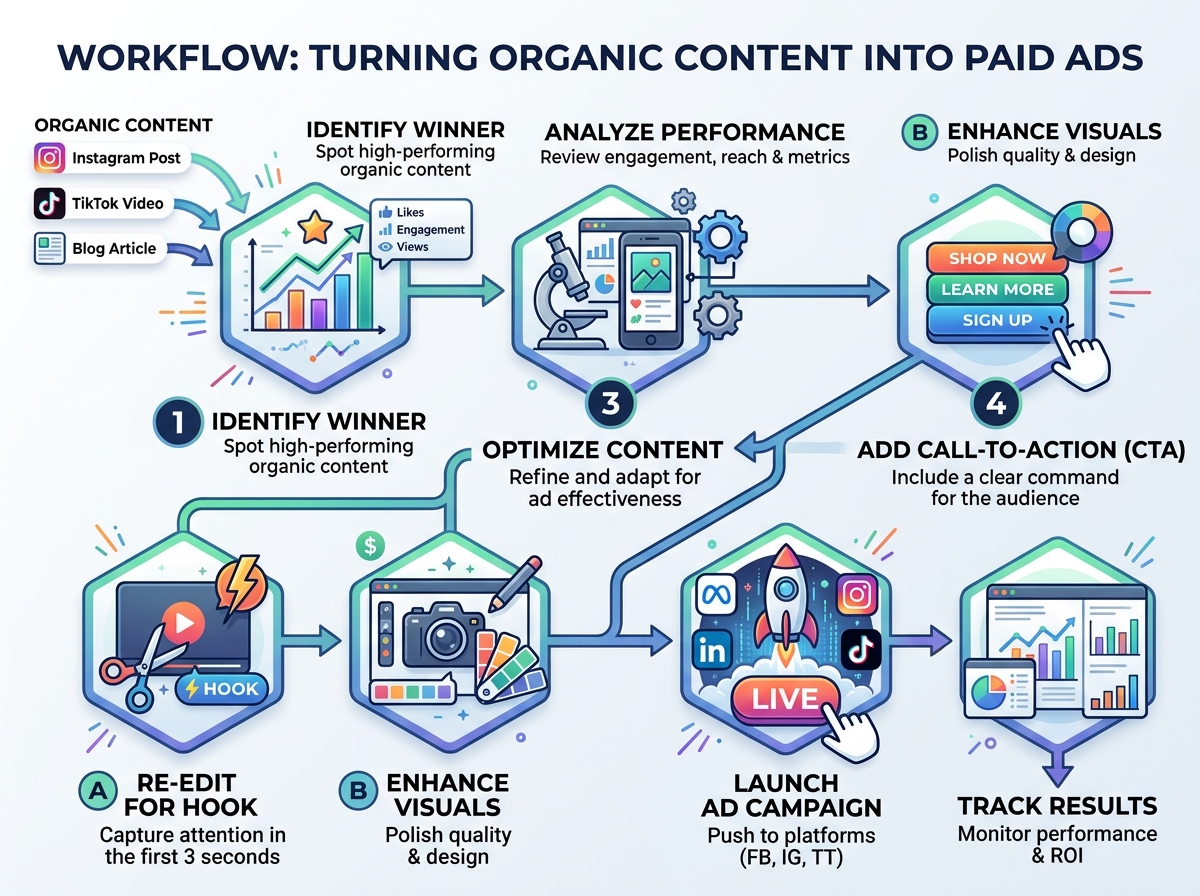
Instead of simply boosting organic posts, use them as a creative testing ground. Identify your top-performing organic videos and use them as a foundation to build dedicated paid creatives. This process involves re-editing and restructuring, not just hitting the "Promote" button.
- Identify Winning Organic Concepts: Look for organic videos with high watch times and engagement rates. These are your proven concepts. The content has already demonstrated its ability to hold attention.
- Re-edit with a Strong Hook: Replace the original opening with a direct, problem-oriented hook designed for a cold audience. Examples include "Stop guessing your foundation shade" or "The perfect fall jacket doesn't exi—".
- Structure for Conversion: Re-cut the video to follow a clear narrative: Hook -> Problem -> Solution -> CTA. Show the product in action and clearly demonstrate its value. Add text overlays to reinforce key benefits.
- Add a Clear and Compelling CTA: End your video with a direct call-to-action that aligns with your campaign goal. Use TikTok's native CTA buttons and consider adding a verbal CTA in the voiceover.
- Optimize for Sound-On and Sound-Off Viewing: Use a combination of trending audio (from TikTok's Commercial Music Library), a clear voiceover, and on-screen captions to ensure your message is understood in any viewing environment.
Which creative elements should you optimize for TikTok Spark Ads and Promote?
While often grouped together, Spark Ads and Promote serve different functions and require different creative considerations.
Promote is a tool within the TikTok app that allows you to boost an existing organic video to a wider audience. It's best used for top-of-funnel awareness goals, as the creative is still fundamentally organic. When using Promote, choose videos that are broadly appealing and represent your brand's voice well.
Spark Ads, on the other hand, are a format within TikTok Ads Manager that lets you use organic posts from your own account (or a creator's) as the creative for a full-fledged ad campaign. This is where the adaptation process is crucial. The organic post serves as the foundation, but it's the targeting, bidding, and optimization within Ads Manager that drives performance. For Spark Ads, you should be using content that has been re-edited for a conversion-focused goal, even if it started as an organic post.
Analyzing Creative Performance with EngageReel
Manually tracking which organic concepts to adapt and constantly refreshing creative is a significant bottleneck for most fashion brands. EngageReel’s AI platform automates this process. It analyzes the creative elements of your top-performing organic and paid content—hooks, scenes, pacing, audio—and identifies the patterns that are actually driving conversions and ROAS. The Content Engine then uses these insights to generate new, high-potential ad creatives, allowing your team to move from guesswork to data-driven creative development. Learn how EngageReel can help you scale your TikTok ads.
Frequently asked questions
Can you use organic TikToks for ads?
Yes, you can use organic TikToks for ads, primarily through formats like Spark Ads. However, for best results, you should adapt the organic content by re-editing it to include a strong hook, a clear call-to-action, and a structure optimized for conversion, rather than simply boosting the original post.
What is the difference between TikTok Promote and Spark Ads?
Promote is a simple in-app tool for boosting organic videos to a broader audience, best for awareness goals. Spark Ads are a more sophisticated ad format within TikTok Ads Manager that uses organic posts as the creative in a full campaign, allowing for advanced targeting, bidding, and optimization for conversion goals.
How do I make my TikTok ads more effective?
To make your TikTok ads more effective, focus on creating content that feels native to the platform but is structured for conversion. Hook viewers in the first three seconds, clearly present a problem and your product as the solution, use a strong CTA, and constantly test new creative variations to avoid ad fatigue.
What makes a good TikTok ad creative?
A good TikTok ad creative is authentic, fast-paced, and entertaining. It typically features real people (creators, customers), uses trending sounds from the Commercial Music Library, and follows a clear Hook -> Problem -> Solution -> CTA structure. According to a 2026 Bevy Commerce report, lower-production, UGC-style content often outperforms highly polished ads because it feels more genuine.
How often should I refresh my TikTok ad creative?
Creative fatigue is rapid on TikTok. It's recommended to refresh your ad creatives every 1-2 weeks, or sooner if you notice a consistent decline in performance metrics like CTR and an increase in CPA. Continuously introducing new variations into existing ad groups is more effective than creating new campaigns from scratch.
References
- TikTok for Business — Creative best practices for performance ads (2026)
- Bevy Commerce — TikTok Ads Strategy & Creative Best Practices for 2026
- Flighted — TikTok Organic vs Paid Ads: The Right Approach For Each (2026)
- Later — The Ultimate Guide to TikTok Marketing (2026)
- Shopify Blog — A Beginner's Guide to Advertising on TikTok (2026)