
How to Test Ad Hooks Without Resetting Meta Learning Phase
In this article
- Why adding new ad creatives directly into scaling campaigns triggers Meta learning resets and CPM spikes.
- How to set up isolated sandbox testing ad sets versus Dynamic Creative (DCT) for rigorous hook validation.
- Step-by-step framework to isolate the first 3 seconds while keeping body copy and calls-to-action constant.
- Exact protocols for migrating winning hooks into scaled Advantage+ campaigns without dropping performance.
Media buyers and D2C fashion brand owners need to test new video hooks to refresh fatigue, but introducing new creatives or editing live campaigns frequently resets Meta's campaign learning phase. This triggers budget fragmentation, erratic CPM spikes, and sudden ROAS drops across stable scaling ad sets. To test ad hooks without resetting Meta's learning phase, performance teams should use isolated sandbox testing ad sets or Meta Flexible Ads (DCT) with asset iteration while keeping core ad set budgets and campaign structures untouched.
When scaling a fashion or beauty brand on Meta, creative fatigue is an inevitable bottleneck. Within weeks, winning video ads suffer from high frequency and declining click-through rates (CTR). However, the moment a media buyer adds five brand-new video variations directly into an active, scaling ad set, delivery stumbles. Meta's delivery system treats the edit as a structural change, pushes the ad set back into the learning phase, and causes unpredictable cost-per-acquisition (CPA) inflation. Understanding how Meta's delivery algorithm evaluates creative changes is essential for maintaining predictable ad account performance.
Why Adding New Video Hooks Resets Meta's Learning Phase
Meta's delivery algorithm relies on stable conversion data to optimize ad delivery and find profitable user profiles. When you make significant edits to an active ad set—such as adding entirely new ad creatives, altering targeting parameters, or modifying budget structures by more than 20%—the system restarts the learning phase. During this phase, delivery becomes volatile as Meta tests the new assets across different audience segments without historical performance confidence.
Many media buyers make the mistake of editing active winning ads or dumping dozens of untested hook variations into scaling Advantage+ campaigns, which forces Meta to re-enter learning and degrades account delivery. In fashion e-commerce, where visual hooks dictate 80% of a video ad's stopping power, introducing unvetted variations directly into live scaling structures burns budget on unoptimized creative permutations.
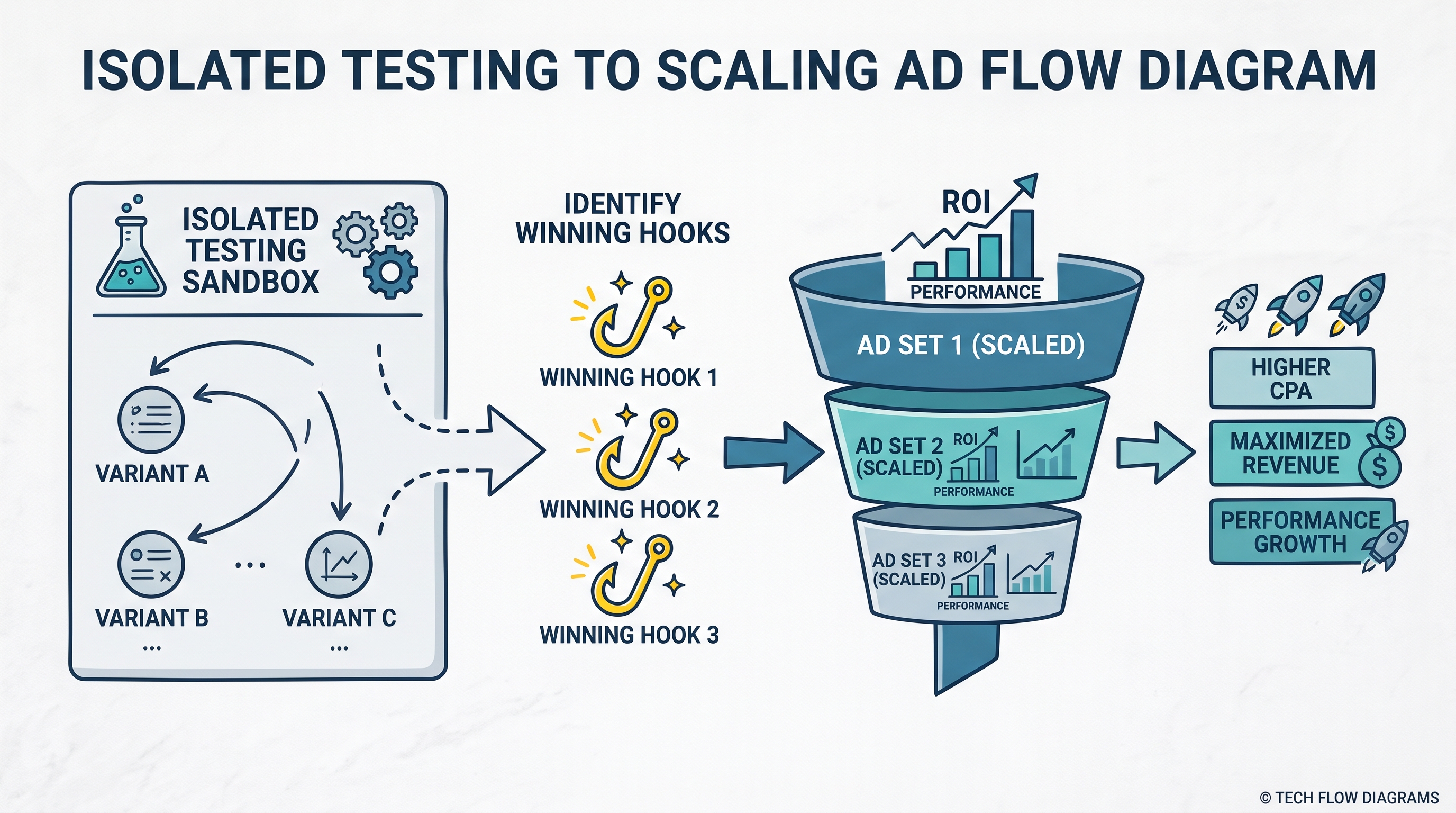
To prevent these costly disruptions, performance teams must decouple creative ideation from scaling distribution. By isolating hook tests in dedicated testing environments, your primary scaling campaigns continue to accumulate stable conversion events uninterrupted.
Sandbox Ad Sets vs Dynamic Creative: How to Structure Hook Tests
Structuring your hook testing framework correctly determines whether you can isolate variables without destabilizing account spend. Two primary architectures dominate professional media buying: isolated sandbox testing ad sets and Meta Dynamic Creative (DCT) / Flexible Ads.
Sandbox Testing Ad Sets (ABO): Operating a dedicated testing campaign using Advantage Campaign Budget (CBO) or Ad Set Budget Optimization (ABO) allows you to allocate a controlled daily budget (e.g., 10% to 20% of total daily spend) exclusively for new creative concepts. Within this sandbox, you test new video hooks against a warm or broad audience without touching your scaling campaigns. If a hook fails, you pause it with zero impact on core revenue generation.
Dynamic Creative Testing (DCT): Meta's Flexible Ads feature enables you to input multiple hook variations (videos 0–3 seconds), primary texts, and headlines within a single ad container. Meta automatically tests combinations to identify winning pairings. However, DCT requires sufficient daily budget to exit learning and gather statistically significant attribution data per asset.
| Testing Method | Best For | Budget Control | Learning Phase Risk |
|---|---|---|---|
| Sandbox Ad Sets (ABO) | Testing distinct video concepts & visual styles | Strict daily cap per ad set | Zero risk to scaling campaigns |
| Dynamic Creative (DCT) | Rapid permutation testing of hooks + bodies | Managed at ad set level | Contained within test container |
| Direct Addition (Avoid) | Emergency creative updates | Uncontrolled | High risk of resetting core ad sets |
How to Isolate the First 3 Seconds While Keeping Body Copy and CTAs Constant
Scientific creative testing requires rigorous isolation of variables. If you change the video hook, the body copy, the middle demonstration, and the call-to-action (CTA) all at once, you will never know which element drove performance improvements.
To isolate hooks effectively, maintain a strict modular creative framework:
- Constant Body & CTA: Keep the middle demonstration (product in motion, fabric close-up, or unboxing) and the final CTA completely identical across all test variations.
- Variable Hook (0–3s): Produce 3 to 5 distinct visual or verbal hooks. Test a problem-first hook, an aesthetic close-up hook, a social proof hook, and a creator-led question hook.
- Controlled Distribution: Run these variations under identical targeting, placement, and bidding conditions to ensure fair evaluation.
By keeping middle scenes constant, any significant variance in 3-video-view rate, CTR, or thumb-stop ratio can be attributed directly to the performance of the individual hook.

Deploying Winning Video Hooks Into Scaling Campaigns Without Performance Drops
Once a testing sandbox identifies a winning hook that achieves a superior thumb-stop ratio and cost-per-acquisition over a 7-day window, the next challenge is migrating that asset into your scaling campaigns without triggering a learning phase reset.
Here is the proven protocol for migrating winning hooks:
- Post-ID Duplication / Existing Post ID: Never re-upload the video file as a brand-new ad inside your scaling campaign. Instead, pull the Post ID (organic or existing ad post ID) from the winning test ad and use "Existing Post" when creating the ad in your scaling campaign. This preserves all accumulated social proof (likes, comments, shares) and prevents delivery resets.
- Gradual Introduction: Introduce the winning ad into a scaling ad set with steady budget pacing. Avoid bulk-loading ten new ads simultaneously.
- Monitor Stability: Observe CPM and CPA stability for 48 to 72 hours post-migration before scaling the ad set budget further.
EngageReel's ad intelligence platform automates this entire lifecycle, identifying winning hook patterns from your testing sandbox and generating instant variations ready for seamless deployment across Meta, Google, and TikTok ad accounts.
Frequently asked questions
Does adding a new ad to an existing Meta ad set reset the learning phase?
Adding a new ad creates a minor adjustment period for that specific creative asset, but it does not completely reset the ad set's learning phase unless you make major edits to budget (exceeding 20%), targeting, or bidding structures concurrently.
How many conversion events are needed to complete a hook test in Meta Ads?
To achieve statistical significance, aim for at least 50 optimization events per ad set within a 7-day window, or rely on leading indicators such as Thumb-Stop Ratio (3-second video views divided by impressions) and CTR for faster creative iteration.
What is the best campaign structure for testing video hooks on Meta?
An isolated sandbox campaign utilizing Ad Set Budget Optimization (ABO) or dedicated CBO test ad sets is the most reliable structure. It protects your primary scaling campaigns from volatility while providing a controlled budget for creative experiments.
Should you use ABO or CBO when testing new fashion ad hooks?
ABO (Ad Set Budget Optimization) is generally preferred for creative testing because it guarantees equal spend distribution across all tested hook variations, preventing Meta's algorithm from prematurely starving new ads.
How do you prevent creative fatigue without restarting campaigns?
Prevent creative fatigue by continuously cycling pre-vetted winning hooks from your testing sandbox into scaling ad sets using existing Post IDs, preserving social proof and avoiding campaign-level learning resets.