
Creative is the New ROAS: A Fashion Brand's Guide

In this article
For fashion brands stuck with flat or declining ROAS, the instinct is often to increase spend or offer deeper discounts. This guide reframes the problem, showing how the most significant gains come from a disciplined, data-driven creative strategy. It’s for performance marketers and growth leads who need to make their ad budget more profitable.
- Understand the data linking creative to profitability
- Identify the four key creative levers that impact ROAS
- Implement a structured creative testing framework
- See how AI-powered platforms can automate this workflow
For evidence-backed context, see our D2C fashion ROAS case study and creative fatigue playbook before restructuring campaigns.
How do you increase ROAS when bids are maxed out and the market is saturated? The highest-leverage answer isn't in the budget; it's in the creative. For fashion brands, creative quality and testing frequency have become the primary drivers of profitable ad spend, with data showing that creative accounts for over 50% of Meta Ads performance in 2026.
Why is My ROAS So Low (And It’s Not My Bids)?
Many fashion brands hit a ROAS ceiling and immediately blame platform costs or audience saturation. While CPMs have risen, the more common culprit is creative fatigue. Shoppers in the fashion space burn out on repetitive visuals incredibly quickly. According to Veicolo Agency, most fashion brands should be refreshing their ad visuals every 10–21 days to avoid a decline in click-through rates and a rise in costs. When the same studio shots run for a month, the algorithm shows them to the same people, engagement drops, and your ROAS stagnates. This isn't a bidding problem; it's a creative pipeline problem.
Furthermore, the median ROAS for fashion brands on Meta sits at just 2.18x, a figure that barely covers costs for many. Yet, the top 10% of brands are achieving an impressive 6.0x ROAS. The difference isn't their budget; it's their systematic approach to creative development and testing. They treat creative not as a static asset, but as a dynamic variable to be optimized. A focus on improving creative is one of the most effective ways to increase ROAS for fashion brands, moving from baseline performance toward the top tier.
How Does Ad Creative Actually Impact ROAS?
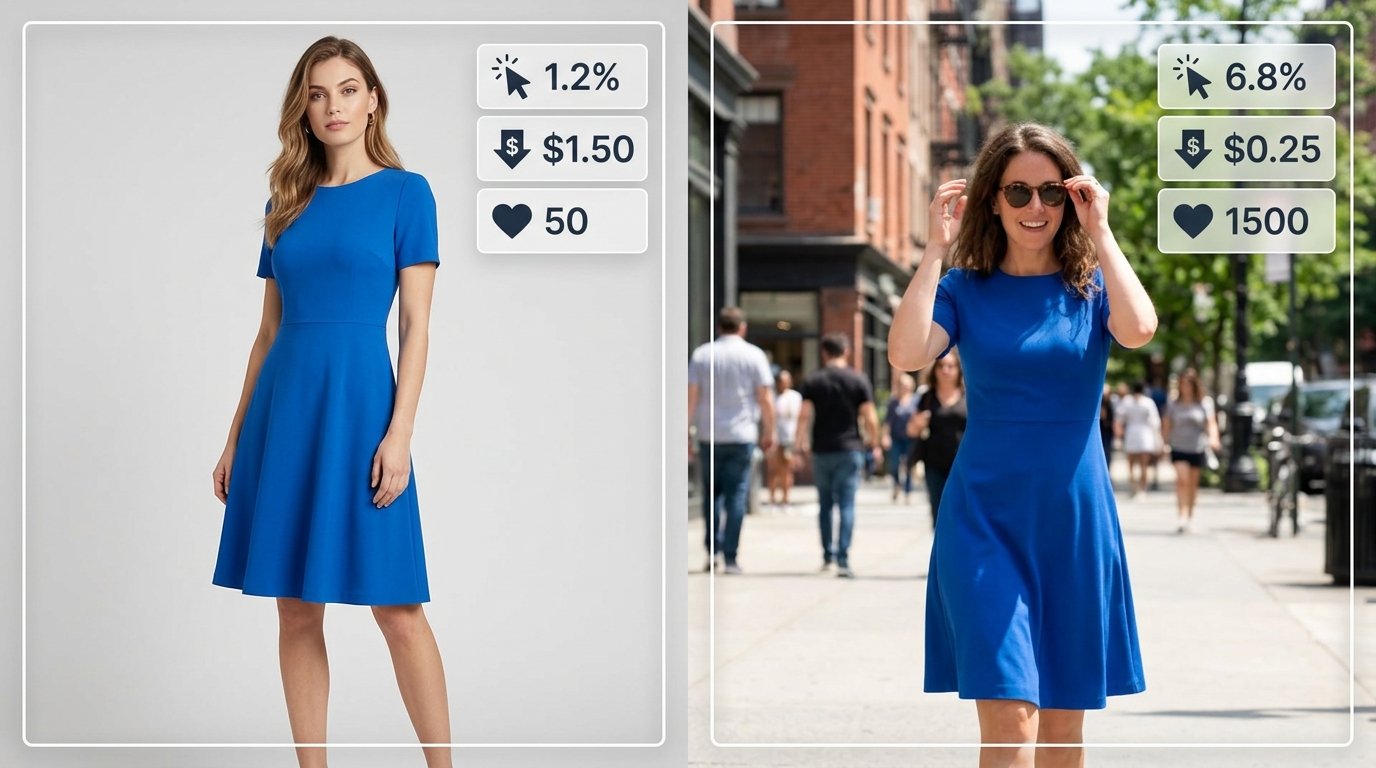
The link between creative and ROAS is direct and quantifiable. Stronger creative lowers acquisition costs and increases the perceived value of your products, which boosts conversion rates. For example, User-Generated Content (UGC) is shown to outperform polished studio ads, delivering a 24% higher ROAS on average because it builds trust and authenticity. A shopper is more likely to convert after seeing a real person wearing and styling the product.
This isn't just about single ads. Meta's algorithm favors accounts with a diverse portfolio of creative assets. Brands that test 21 or more new creatives each month see significantly better ROAS than those testing fewer than 10. A steady stream of fresh, varied creative keeps your audience engaged, tells the algorithm you have more to offer, and ultimately makes every dollar of ad spend work harder. This AI ad performance and creative for fashion eCommerce approach ensures that campaigns remain fresh and effective, preventing the performance dips associated with ad fatigue.
What Are the 4 Creative Levers That Drive 90% of ROAS Gains?
Instead of testing random elements, focus on the four areas that have the most impact on performance. Systematically testing variations of these levers will yield more predictable and scalable results.
- The Hook: The first 3 seconds of a video or the primary image. Test different openings: unboxing, a question, a dramatic product shot, or a UGC-style clip.
- The Angle: The core message or value proposition. Are you highlighting comfort, style, versatility, or a specific use-case? Test a "3 ways to style" concept against a "fabric close-up" to see what resonates.
- The Format: Video vs. static image vs. carousel. Within video, test different lengths and styles (e.g., fast-paced cuts vs. slow, aesthetic shots).
- The Call-to-Action (CTA): Both the text and the visual cue. Test different button copy, but also visual cues that direct the user to the next step.
Can a Playbook for High-ROAS Creative Testing Really Work?
A disciplined testing framework prevents wasted spend and provides clear, actionable insights. A structured testing plan moves creative from a guessing game to a system for growth.
This playbook provides a clear path from initial idea to a scaled, high-performing ad. It ensures that budget is allocated efficiently, with the majority reserved for creatives that have proven their ability to drive results. By focusing on key metrics at each stage, you can make data-driven decisions that systematically improve your ROAS over time.
| Phase | Objective | Budget Allocation | Duration | Key Metric |
|---|---|---|---|---|
| 1. Concept Testing | Test 4-5 fundamentally different creative angles. | 10-15% of total | 3-5 days | Click-Through Rate (CTR) |
| 2. Iteration | Take the winning concept and test 3-4 variations (hooks, CTAs). | 20-30% of total | 5-7 days | Cost Per Add-to-Cart |
| 3. Scaling | Allocate remaining budget to the top 1-2 winning ads. | 60-70% of total | Ongoing | ROAS |

Discover How EngageReel Automates Creative-Led Growth
Manually managing this level of testing is unsustainable for most teams. This is where AI ad performance and creative for fashion eCommerce platforms like EngageReel become essential. EngageReel connects to your ad accounts and product feed, automatically generating creative variations based on your best-sellers and top-performing ad elements. It then runs structured tests, identifies winning combinations of hooks, angles, and formats, and reallocates budget to scale what works—24/7. This allows you to move from testing a handful of creatives per month to deploying hundreds, systematically increasing your ROAS without increasing your team's workload. You can learn more at app.performanceloop.ai.
Explore KPIs You Should Measure Beyond ROAS
While ROAS is a critical metric, it doesn't tell the whole story, especially when you factor in returns and other costs. To get a true picture of profitability, you need to track a few other key performance indicators.
- Marketing Efficiency Ratio (MER): This is your total revenue divided by your total marketing spend. It gives you a holistic view of performance across all channels.
- Contribution Margin ROAS: This metric factors in your product costs and variable fees, giving you a much clearer picture of actual profit from your ad spend.
- Customer Acquisition Cost (CAC) Payback Period: How long does it take to earn back the money you spent to acquire a new customer? A shorter payback period means more sustainable growth.
Fashion brands that optimize for contribution margin and CAC payback—not just platform ROAS—are the ones that build lasting, profitable businesses. This strategic focus ensures that growth is not just rapid, but also sustainable and financially sound, preventing the cash flow issues that can arise from pursuing revenue at all costs.
Frequently asked questions
What is a good ROAS for a fashion brand?
While the median ROAS on Meta is 2.18x, a 'good' ROAS depends on your profit margins. A brand with 50% margins might be profitable at 2.5x, while a brand with 35% margins needs over 2.86x just to break even. Top-performing brands aim for 4x to 6x ROAS, as reported by AdAmigo.ai (2026).
How often should I refresh my ad creative?
To combat ad fatigue, fashion brands should refresh ad visuals every 10–21 days. During high-spend periods like holidays, you may need to update them weekly. Consistent freshness is key to maintaining engagement and efficiency.
Does UGC really work better than studio photography?
Yes. Studies and platform data consistently show that User-Generated Content outperforms polished studio shots. On average, UGC can deliver 24% higher ROAS and 48% higher click-through rates because modern consumers find it more authentic and trustworthy.
How can I increase my Average Order Value (AOV) to improve ROAS?
Use tactics like product bundling, 'complete the look' suggestions, and free shipping thresholds. For fashion, bundling can boost AOV by 20-40%. A higher AOV directly increases your ROAS without requiring any additional ad spend.
What's the best way to start testing ad creative?
Start with a structured, multi-phase approach. First, test 4-5 broad concepts to find a winning angle (measure CTR). Then, iterate on that winner with different hooks and formats (measure Cost Per Add-to-Cart). Finally, scale the top 1-2 ads with the majority of your budget (measure ROAS).
References
- AdAmigo.ai — Fashion eCommerce Meta Ads ROAS Benchmarks (2026)
- Veicolo Agency — How to Improve ROAS in Online Fashion Advertising Campaigns? (2026)
- Meta for Business — Advantage+ Shopping Campaigns
- Shopify Enterprise Blog — How to Use UGC in eCommerce Marketing
- Modern Retail — Marketing News and Analysis