
How to Reduce Cost per Purchase on Meta Ads (2026)
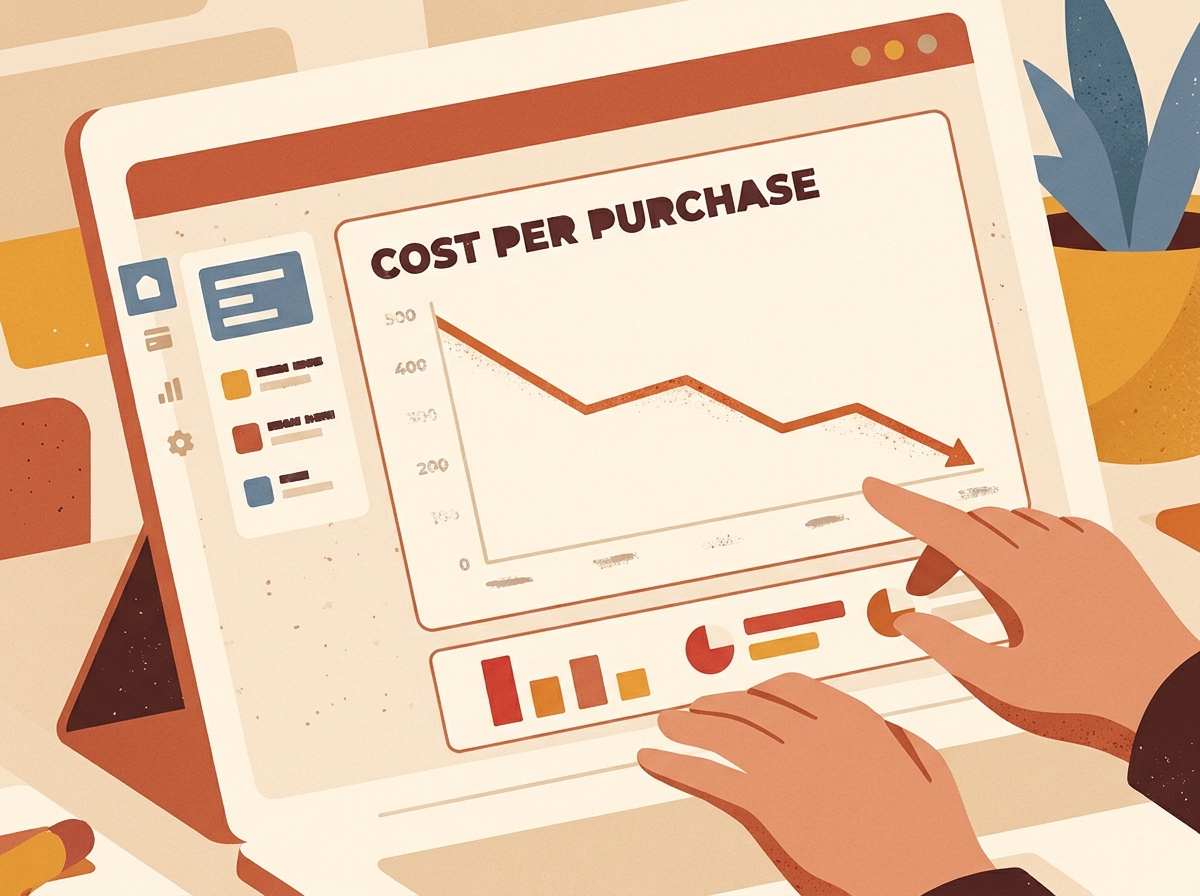
This guide provides a structured approach for D2C and Shopify brands to lower their Meta Ads cost per purchase (CPP), addressing recent platform changes and common tracking issues for Indian and GCC markets.
- Understand if your CPP has genuinely increased after Meta's 2026 attribution update.
- Calculate your break-even CPP to set realistic and profitable optimization goals.
- Fix foundational tracking issues with the Conversions API before adjusting campaigns.
- Restructure campaigns to exit the learning phase faster and improve optimization.
Is your Meta cost per purchase climbing? Before you change a single ad, you need a systematic approach. The solution starts with knowing your numbers—what you can afford to pay for a customer—and confirming the problem isn't just a reporting change. From there, it's a matter of fixing your data signal, campaign structure, and creative in that specific order.
Has Your Cost Per Purchase Really Gone Up?
The first thing to verify is whether your costs have actually risen. On March 3, 2026, Meta announced a significant change to attribution: click-through conversions for websites would henceforth count only link clicks. Other interactions like likes, shares, and comments were moved into a new "engage-through" category. This means purchases previously attributed as click-through might now appear under a different label, artificially inflating your reported CPP while real sales remain unchanged.
How to Verify in 15 Minutes
- Establish a new performance baseline starting from when the "engage-through" column appeared in your account (around mid-March 2026 for most). Avoid comparing current CPP to data from before this shift.
- In Ads Manager, use the "Compare attribution settings" tool to view click, engage-through, and view-through data side-by-side. The default is typically 7-day click, 1-day engage-through, and 1-day view-through.
- Cross-reference the purchase data in Ads Manager with actual orders in your Shopify or WooCommerce backend for the same period.
- Calculate your blended Marketing Efficiency Ratio (MER), which is total store revenue divided by total ad spend. If MER is stable but reported CPP is up, the issue is likely with reporting, not performance.
What Is the Break-Even CPP You Should Steer By?
Your break-even CPP is the ceiling—the maximum you can spend to acquire a customer before that order becomes unprofitable. Without this number, any effort to "lower CPP" is just guesswork. The formula is your net revenue minus all associated costs, including product, shipping, payment gateways, and potential losses from returns (RTO).
Example: A ₹1,180 Order with COD in India
Let's say an item sells for ₹1,180, including 18% GST, making net revenue ₹1,000. If the product costs ₹350, shipping is ₹80, and gateway fees are ₹25, you are left with ₹545 per delivered order. Assuming a 10% RTO rate and a ₹160 loss on each returned order (for two-way shipping), the calculation changes.
| Metric (per 1,000 reported purchases) | Amount |
|---|---|
| 900 delivered orders × ₹545 profit | ₹4,90,500 |
| 100 RTO orders × ₹160 loss | − ₹16,000 |
| Total profit before ad spend | ₹4,74,500 |
| Break-even CPP (Total profit ÷ 1,000) | ~₹475 |
In this scenario, a reported 2.5x ROAS might look healthy, but spending ₹475 per purchase yields zero profit. A smart target CPP should be around 70-75% of your break-even point, roughly ₹330-350 here, unless strong repeat purchase data justifies a higher acquisition cost.

Why You Must Fix the Signal Before Touching the Ads
Inaccurate tracking is a primary driver of high CPP. If Meta cannot accurately see who converts, it cannot efficiently find more people like them. Fixing your data feed is the highest-leverage action you can take.
- Set Data Sharing to Maximum: For Shopify stores using the Facebook & Instagram app, Meta's documentation confirms that setting data sharing to "Maximum" sends customer details via the Conversions API (CAPI), significantly improving event matching.
- Eliminate Hardcoded Pixels: If you have a pixel manually pasted into your theme code alongside the official app integration, you're likely double-counting events. This makes CPP look artificially low until the duplicate is removed, causing a sudden apparent spike.
- Verify in Events Manager: Ensure that Purchase events are being received from both Browser and Server sources and that the system is correctly deduplicating them.
For D2C brands in India and the Gulf region, Cash on Delivery (COD) presents another tracking challenge. A "Purchase" event fires when a COD order is placed, not when it's delivered and paid for. This teaches the algorithm to find users who place orders but may not complete the purchase, skewing your real CPP higher than what's reported. Address this by encouraging prepaid orders and analyzing spend against delivered orders, not just reported ones.
How Consolidating Ad Sets Reduces Costs
Spreading your budget across too many ad sets prevents any single one from gathering enough data to optimize effectively. According to Meta, an ad set needs approximately 50 optimization events (e.g., purchases) within a seven-day window to exit the learning phase. The math is straightforward: your daily budget per ad set should be roughly (Target CPP × 50) / 7. With a ₹350 target CPP, that's about ₹2,500 per day for each ad set. If your account spends ₹10 lakh per month (~₹33,000/day), you can only adequately fund about 13 ad sets. More than that, and you're likely limiting performance.
What is the right campaign structure for 2026?
The structure of Meta's advertising platform has evolved. As of May 2026, the standalone Advantage+ Shopping (ASC) campaign type was retired. The functionality now exists within the standard "Sales" objective. A Sales campaign is considered "Advantage+" when you enable Advantage+ campaign budget, audience, and placements. This simplifies setup but requires a disciplined approach to consolidation. Instead of running dozens of narrow interest-based ad sets, focus on 8-10 consolidated ad sets containing your top-performing ads.
Does Better Creative and Bidding Lower CPP?
High-quality, engaging creative directly lowers your cost per purchase. Meta's auction rewards ads that generate positive interactions and are more likely to lead to action. In broad-targeting campaigns, the creative is what determines who sees the ad. Test distinct concepts—like a problem-solution video versus a customer unboxing—rather than minor tweaks. Monitor frequency, CTR, and CPP together over a 7-day period. If frequency and CPP are rising while CTR is falling, it's a strong signal of creative fatigue. Find more on this in our guide to beating creative fatigue.
Which bid strategy should you choose?
Your choice of bid strategy depends entirely on your break-even CPP calculation.
| Strategy | What it does | When to use |
|---|---|---|
| Highest volume | Maximizes the number of purchases within your budget, without controlling cost. | Use for new accounts or when your CPP is already comfortably below your target. |
| Cost per result goal | Aims for a specific average CPP that you define. | Use when CPP is unstable and you have consistent purchase volume. |
| ROAS goal | Aims for a specific return on ad spend. | Use when your products have widely varying order values. |
Meta is clear that tighter cost controls can limit spend. Start with a cost per result goal set at your break-even CPP, then gradually lower it by 10% increments, allowing at least three days for the algorithm to adjust.
How EngageReel Fits
Optimizing these variables manually—tracking attribution shifts, calculating break-even points, monitoring creative fatigue, and adjusting bids—is a continuous, data-intensive process. EngageReel is an AI ad performance and creative platform for fashion ecommerce that automates this workflow. It connects ad performance directly to creative elements, identifying which hooks, models, and scenes are driving results. The platform helps you consolidate campaigns effectively and provides data-driven recommendations to lower your cost per purchase without constant manual oversight. Learn more at EngageReel.com.
What are the post-click factors that lower CPP?
Your cost per purchase is a simple equation: ad spend divided by purchases. Therefore, increasing the number of purchases from the same number of clicks will lower your CPP without any changes to your ads. For example, if you spend ₹15,00,000 to get 150,000 sessions at a 1% conversion rate, you get 1,500 purchases at a CPP of ₹1,000. Improving your conversion rate to 1.5% yields 2,250 purchases, dropping your CPP to ₹667.
Key Conversion Fixes for the Indian Market
- Monitor the gap between link clicks and landing-page views, as a large drop-off often indicates slow page load times on mobile networks.
- Clearly display UPI and COD payment options early in the checkout process.
- Ensure the offer and price from your ad are immediately visible on the landing page without requiring the user to scroll.
Additionally, increasing your Average Order Value (AOV) through tactics like bundling, free shipping thresholds, and post-purchase upsells allows you to afford a higher CPP while maintaining profitability.
Frequently asked questions
What is a good cost per purchase on Meta ads?
A "good" CPP is relative to your business's margins. It should be comfortably below your break-even cost per purchase, which accounts for net revenue, product costs, shipping, fees, and return rates. A common target is to aim for a CPP that is 70-75% of your break-even number.
Why did my Meta cost per purchase suddenly increase in 2026?
A sudden increase around March 2026 is likely due to Meta's change in attribution reporting. The platform began counting only link clicks for click-through conversions, moving other engagements to a new category. Check your blended MER and compare Ads Manager data with your store's actual orders to confirm if it's a reporting issue or a real performance drop.
Should I use cost per result goal or highest volume?
Begin with "highest volume" to gather initial data and establish a baseline. Once you have steady purchase volume but your CPP is volatile, switch to a "cost per result goal." Set the initial goal near your break-even CPP and reduce it incrementally to avoid stalling delivery.
How many purchases are needed to exit the learning phase?
Meta's guidance suggests an ad set needs around 50 optimization events (purchases, in this case) within a 7-day period to exit the learning phase. This is why consolidating your budget into fewer ad sets is crucial for faster, more effective optimization.
Does the Conversions API lower cost per purchase on Shopify?
Yes, it can. By creating a more reliable data connection between Shopify and Meta, the Conversions API allows Meta to better attribute purchases and find more users likely to convert. For best results, enable "Maximum" data sharing in the Facebook & Instagram app and ensure you don't have a duplicate, manually installed pixel.
References
- Meta Business Help Center — About cost per result goal
- Meta for Business — Facebook Bid Strategy Guide
- Meta Business Help Center — About data sharing settings for the Facebook & Instagram app on Shopify
- Shopify Blog — Everything You Need to Know About the Conversions API
- PPC Land — Meta Deprecates Legacy Campaign APIs For Advantage+ Structure