
How to Keep Products Consistent in AI-Generated Images & Video
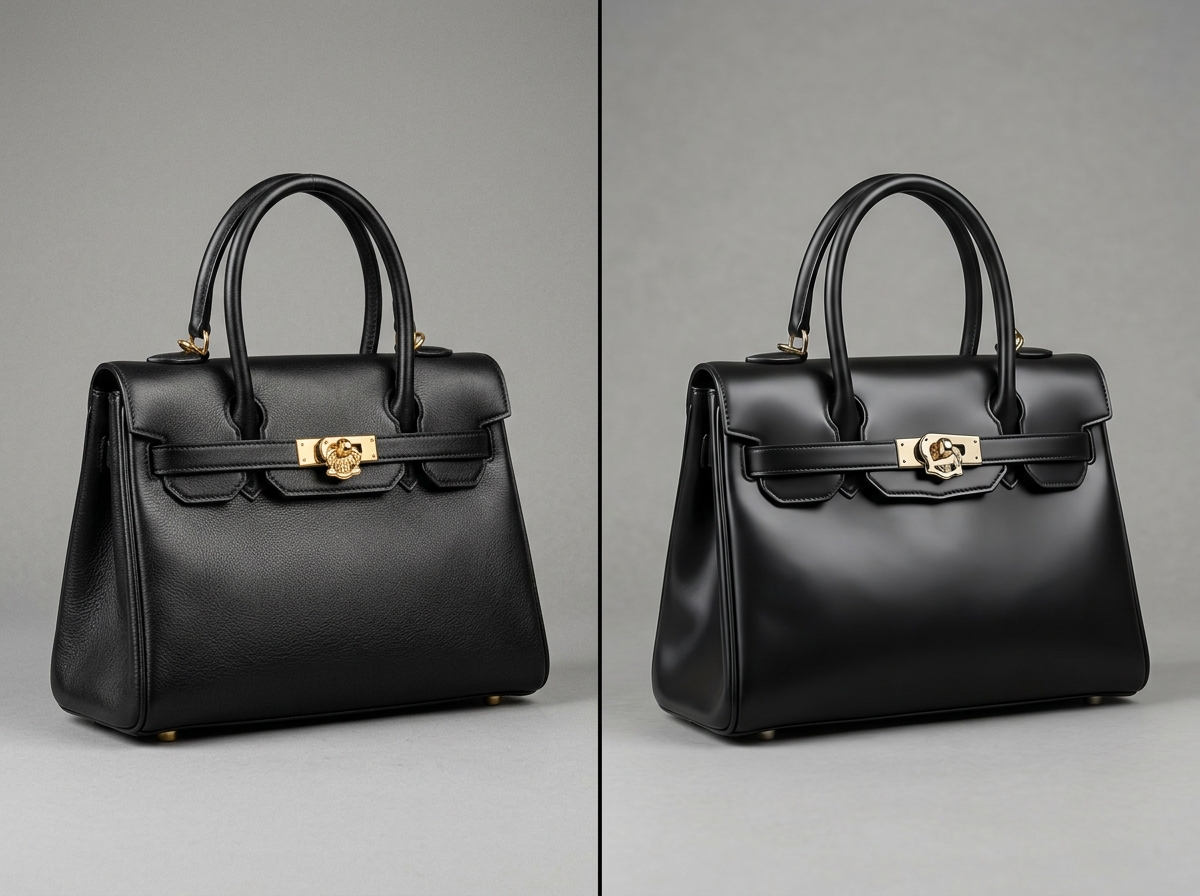
This article provides a diagnostic guide for maintaining product consistency in AI-generated marketing assets. It is for performance marketers and e-commerce teams who need to scale creative production without sacrificing product accuracy. You will learn how to identify, prevent, and fix AI product drift to ensure your advertising is commercially accurate.
- Identify the product attributes most vulnerable to AI alteration.
- Implement a three-step workflow: Reference, Generate, Inspect.
- Use a product-fidelity checklist for repeatable QA.
- Understand how consistent assets improve creative testing with EngageReel.
How do you keep products consistent in AI-generated images when the technology seems designed for infinite variation? The solution is to establish a controlled product reference, clearly separate fixed product attributes from creative variables, and perform a rigorous product-fidelity QA check on every single output. For fashion e-commerce, this process is not optional—it’s the foundation of reliable creative testing and scalable performance.
Why Does AI Change Product Details?
AI image generation models, particularly diffusion models, don't "see" or "understand" a product like a human does. They deconstruct reference images into a series of statistical patterns (noise) and then reconstruct a new image from a text prompt and that learned noise pattern. During this reconstruction, they can interpret prompts in ways that produce visually plausible but commercially inaccurate results. Even with a strong reference image, the model's goal is to create a believable new scene, not to perfectly replicate the source product within that scene unless explicitly controlled. This is why a black garment might render as charcoal grey, or an intricate pattern might simplify—the model prioritizes the overall coherence of the new image over the specific details of the product within it.
Which Product Attributes Are Most Vulnerable to AI Drift?
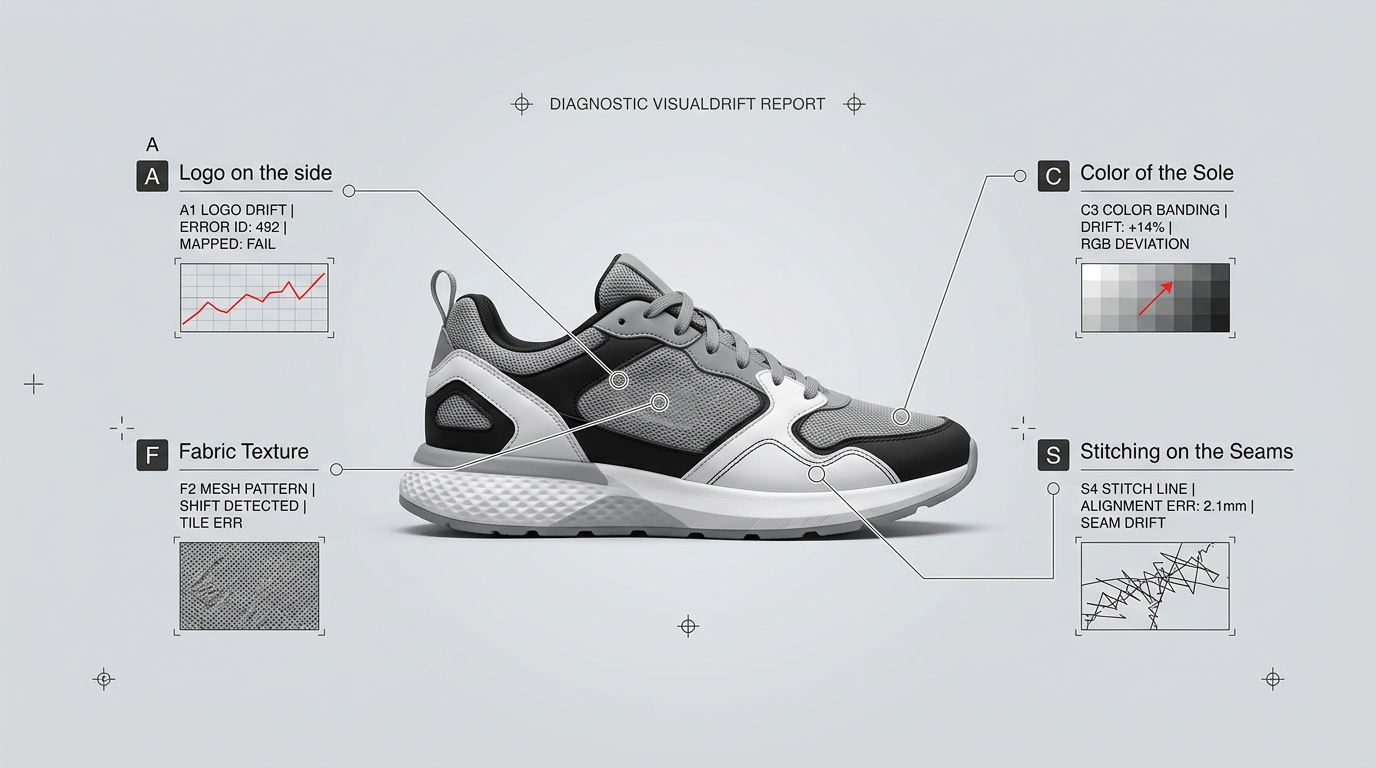
While any product detail can be altered, some are more susceptible to "AI drift" than others. These subtle changes can invalidate an entire set of marketing creatives. Teams need to be most vigilant about:
- Color and Texture: A specific Pantone shade becoming a near-miss, or a fabric's texture appearing smoother or rougher than it is. (Illustrative example: A brand's signature "midnight black" leather jacket is rendered in a slightly faded, softer black that misrepresents the material.)
- Logos and Patterns: On-product branding is frequently distorted. Logos can change shape, text can become illegible, and repeating patterns can lose their defined structure. (Illustrative example: A repeating geometric print on a dress becomes warped, with the shapes losing their sharp edges.)
- Hardware and Construction: Zippers, buttons, stitching, and seams can be altered, simplified, or even removed. These details are critical for communicating a product's quality and design. (Illustrative example: A gold-toned zipper on a handbag is rendered as silver, or a double-stitched seam appears as a single stitch.)
- Silhouette and Proportions: The overall shape and fit of a garment can change between scenes, making the product appear different from one image to the next.
How Can Reference Images Enforce Consistency?
A high-quality reference image is the most critical input for maintaining product fidelity. It serves as the "ground truth" for the AI. However, simply providing one isn't enough. The key is to use a clean, well-lit product shot on a neutral background (a typical "packshot"). This isolates the product from any creative or environmental variables, giving the AI a clear pattern to preserve. When a product is shot in a complex scene, the AI has to distinguish product from background, lighting, and reflections, increasing the chance of error. A clean reference minimizes this ambiguity and anchors the generation process to a stable source.
What Is the Framework for Separating Product from Presentation?
To scale creative production, you must separate what must remain fixed (the product) from what is allowed to change (the creative presentation). This is a simple but powerful framework:
| Problem | Cause | Prevention |
|---|---|---|
| Color Drift | AI prioritizes scene lighting over exact color replication. | Use a clean packshot reference; specify color in negative prompts. |
| Logo/Pattern Distortion | AI treats branding as part of the overall texture. | Use control nets or masking to lock the logo area. |
| Hardware Inaccuracy | Small details are simplified during reconstruction. | Use high-resolution reference images; inspect every output. |
By defining these two buckets upfront, you give the AI clear boundaries. Your prompts should focus on describing the variables, while the reference image and control mechanisms (like inpainting masks or fidelity parameters in advanced tools) lock down the constants.
The Reference → Generate → Inspect Workflow
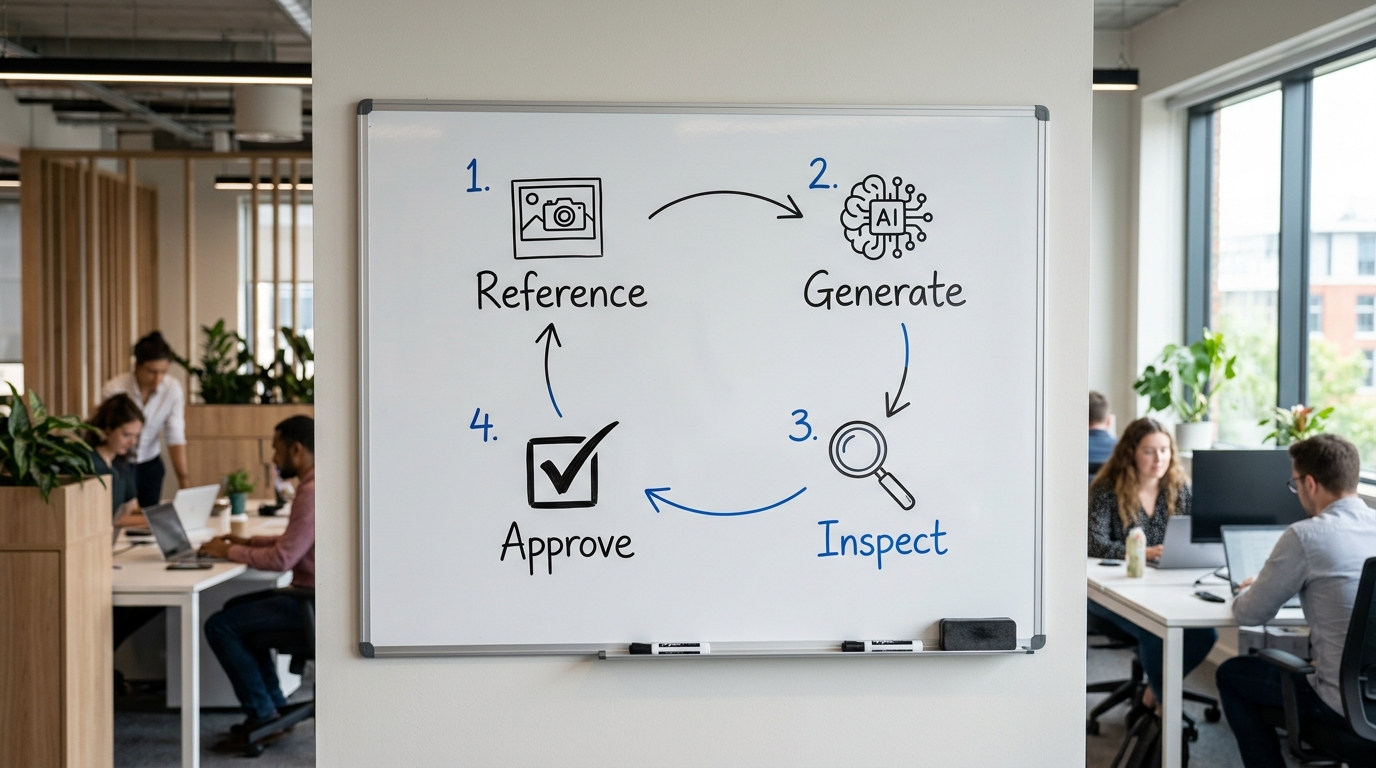
A reliable process for generating consistent assets follows a simple loop:
- Reference: Start with a high-fidelity, approved product packshot as your reference image.
- Generate: Create a batch of images using prompts that describe the desired creative presentation (the variables).
- Inspect: Perform a QA check on every single generated image against your product-fidelity checklist.
- Approve/Reject: Approve only the images that pass the QA check. Reject any with even minor product drift and regenerate.
Do You Keep a Product Consistent Across Multiple Images and Videos?
Consistency across a full campaign—multiple images and video scenes—requires an extra layer of control. The most effective method is to use the same seed or a consistent character/product reference feature if the AI platform supports it. This instructs the model to use the same starting point for noise generation, leading to more consistent outputs.
For image-to-video workflows, this is even more critical. Each keyframe in the video should be checked for product fidelity. If the product's proportions or colors shift between scenes, it breaks the illusion and undermines the ad's effectiveness. The goal is a seamless visual narrative where the product remains the stable, recognizable element.
The Commercial QA Checklist for AI-Generated Creatives
Use this checklist as the core of your "Inspect" phase. It should be a simple, non-negotiable gate for every creative asset.
Product-Fidelity QA Checklist
- Color: Does the color exactly match the approved brand RGB/HEX codes?
- Logo: Is the logo clear, correctly shaped, and free of distortion?
- Pattern: Are repeating patterns consistent and correctly scaled?
- Material: Does the texture and finish (e.g., matte, gloss) match the real product?
- Stitching & Seams: Are they visible where they should be and accurate in detail?
- Silhouette: Are the product's proportions and overall shape correct?
- Hardware: Are buttons, zippers, and clasps the correct shape, color, and material?
- Packaging: If shown, is the packaging 100% accurate?
- Text: Is any on-product text legible and correct?
Is Consistency Important for Performance Marketing?
In performance marketing, a creative test is only meaningful if you have a stable variable. If the AI is subtly changing the product in each creative, you're not testing one product with different creative approaches; you're testing different products. This muddies your data and makes it impossible to draw reliable conclusions about what creative angles are actually driving performance.
By ensuring product consistency, you can confidently test creative variables (like backgrounds, models, and calls-to-action) and know that any uplift in performance is due to the creative choices, not an accidental product misrepresentation. This leads to more reliable creative testing, smarter budget allocation, and a scalable production workflow that feeds directly into performance analysis. An internal link to the AI creative production pillar page might be useful.
Leveraging Consistent Creatives with EngageReel
Once you have a system for generating product-consistent creatives at scale, the next layer is performance analysis. EngageReel provides the AI ad performance and creative platform for fashion eCommerce that connects creative decisions to commercial outcomes. While generative tools create the assets, EngageReel analyzes their performance in live campaigns on Meta, Google, and TikTok. It learns what creative elements are resonating with your audience and provides data-backed insights to inform your next generation cycle. This creates a powerful feedback loop: you generate consistent assets, test them, measure the results with EngageReel, and use that data to produce even more effective creatives.
Frequently asked questions
How do I keep products consistent in AI generated images?
The most effective way is to use a high-quality, isolated product photograph as a reference, define which product attributes must remain constant, and use a detailed QA checklist to inspect every generated image for inaccuracies in color, logo, pattern, and construction before use.
What causes product drift in AI images?
Product drift is caused by the AI model's process of deconstructing and reconstructing images based on statistical patterns. It prioritizes creating a visually coherent new scene over perfect replication of the source product, which can lead to subtle but significant alterations of key product details unless specifically controlled.
Can AI keep a product consistent in a video?
Yes, but it requires careful management. Using consistent reference images for each scene or keyframe and leveraging features like seed locking can help maintain consistency. Each scene in an image-to-video sequence must be individually checked against a product-fidelity checklist to prevent drift.
Is it better to use text prompts or reference images for product consistency?
Reference images are far more effective for product consistency. Text prompts are best used to describe the desired creative presentation (background, mood, style), while a strong reference image should serve as the non-negotiable ground truth for the product itself.
How does product consistency affect ad creative testing?
It's fundamental. Without a consistent product, you can't have a valid creative test. If the product changes from one ad creative to the next, you don't know if performance changes are due to the creative wrapper or the product variation. Consistency isolates the creative as the variable being tested, leading to reliable data.
References
- McKinsey & Company — The State of Fashion 2024 (2023)
- Meta for Business — How AI is powering a new era in performance marketing (2023)
- Coresight Research — The New Era of Creativity: Generative AI in Retail (2024)
- Glossy — Fashion brands are getting more experimental with generative AI (2023)
- Baymard Institute — Product Page Usability: Improve the Product Photo Gallery & Imagery (2024)