
How to Create AI UGC Video Ads for E-commerce

This playbook provides a step-by-step framework for creating and testing high-performing, AI-generated UGC-style video ads. It's designed for performance marketers and e-commerce brands looking to scale their creative output for paid social campaigns while maintaining brand integrity and performance.
- Understand the anatomy of a successful AI UGC ad
- Learn to write scripts that connect with a specific audience problem
- Systematically generate and test creative variations
- Connect creative performance to your next production cycle with EngageReel
How do you create AI UGC video ads that actually convert? You follow a structured, seven-part workflow: start with a specific audience problem, write a hook and script that directly addresses it, generate a creator-style presentation with a believable voice, edit for social-native pacing, and create a clear call-to-action. This process replaces the logistical challenges of traditional UGC with a system for repeatable, data-informed creative development.
What is AI UGC (and What is it Not)?
AI-generated User-Generated Content (AI UGC) is a category of synthetic media designed to replicate the style and aesthetic of authentic, creator-filmed videos. Instead of shipping products to creators, brands use AI platforms to generate videos featuring digital avatars, text-to-speech voices, and product imagery. The final output looks and feels like a video a customer might post on TikTok or Instagram, but it's entirely computer-generated.
It is crucial to distinguish this from genuine customer testimonials. AI UGC is "UGC-style" advertising creative. It is not, and should not be presented as, a real person’s unpaid endorsement. The goal is to leverage a specific, high-performing creative format—the direct-to-camera, lo-fi video—at scale, not to mislead audiences. Authenticity comes from the quality of the script, the relevance of the problem you're solving, and the accuracy of the product's depiction, not from faking a customer's identity.
When Does AI UGC Make Sense for E-commerce Advertising?
AI UGC is not a replacement for all other forms of creative, but it is a powerful tool for specific advertising jobs. It excels in situations requiring high volumes of creative for testing and iteration, where speed and cost are major factors. According to an analysis by Common Thread Co, brands testing 20+ new ads per month see significantly higher Return on Ad Spend (ROAS). AI UGC makes this level of testing feasible for more brands.
Consider AI UGC when you need to:
- Quickly generate creative for new product launches.
- Combat creative fatigue on high-spending paid social campaigns.
- Test a wide range of hooks, angles, and offers without a large production budget.
- Localize ad creative for different markets with region-specific models and languages.
- Create variations of top-performing organic posts to run as paid ads.
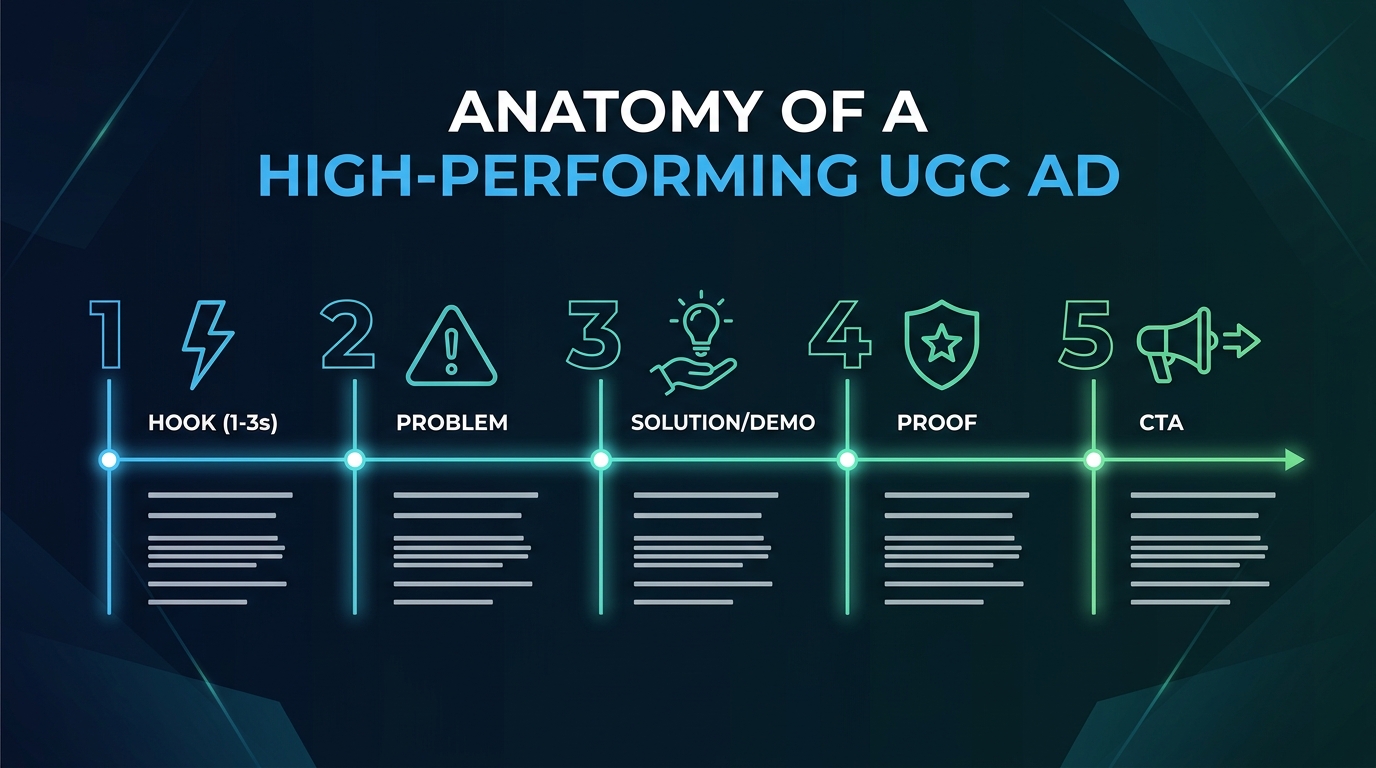
The Anatomy of a High-Performing UGC-Style Ad
Successful UGC-style ads, whether human- or AI-generated, follow a proven structure. They are built to capture attention in the first three seconds and deliver a clear, compelling message in under 30. The core components are the hook, the problem, the solution (your product), a demonstration or proof, and a clear call-to-action.
| Format | Description | Best For |
|---|---|---|
| Problem/Solution | Presents a common customer pain point and introduces the product as the solution. | Products that solve a clear, relatable problem. |
| Product Review | An "unbiased" review of the product's features and benefits. | Building trust and highlighting key features. |
| Unboxing/Demonstration | Shows the product being opened and used for the first time. | Visually appealing products or those with a unique user experience. |
How to Write Scripts That Convert
The script is the most important element of an AI UGC ad. A believable, empathetic script can make an AI-generated video feel authentic, while a generic, salesy script will fall flat. The process starts with the audience, not the product.
- Choose the Audience Problem: Before writing a single line, define the specific problem your product solves for a specific customer segment. "My shoes aren't comfortable" is too broad. "My heels sink into the grass at outdoor weddings" is a specific, relatable problem.
- Write a Natural Hook: The first line determines if the ad gets watched. It must be surprising, relatable, or intriguing.
Example (Fashion): "Stop throwing out your favorite sweaters just because of pilling." Example (Beauty): "I finally figured out how to get my makeup to last through a 12-hour shift." 3. Build the Body: Follow a simple structure: problem → product → demonstration → proof/value → CTA. Show the product in action. Explain why it works. Connect it back to the initial problem. 4. Use Conversational Language: Write like a real person talks. Use contractions. Ask questions. Keep sentences short. Read it aloud to catch awkward phrasing.
Generating the Visuals, Voice, and Pacing
Once you have a solid script, the next step is to bring it to life with AI tools. This involves selecting an avatar, generating a voice, and editing the final video for a social-native feel.
- Select the Creator/Avatar Style: Choose an avatar that aligns with your target demographic and brand aesthetic. The goal is relatability, not perfection.
- Generate the Voice and Delivery: Modern text-to-speech engines can produce incredibly realistic voices. Experiment with different tones, paces, and inflections to match the script's emotion. Avoid a monotone, robotic delivery.
- Add Captions, Cuts, and Product Shots: All social video ads should have burned-in captions. Use quick cuts, zooms, and B-roll of the actual product to keep the visual pacing dynamic and engaging. Don't rely on a single, static shot of the AI avatar.

How EngageReel Drives Systematic Testing and Optimization
Creating one AI UGC ad is straightforward. The real value for performance marketers is creating dozens of variations to systematically test what resonates with your audience. This is where an AI ad performance and creative platform for fashion eCommerce like EngageReel becomes critical.
Instead of manually tracking which hook works best with which avatar, you can use a platform to structure your tests. By creating a matrix of hooks, scripts, avatars, and calls-to-action, you can generate a large batch of creatives. EngageReel can then analyze the results from your Meta and TikTok campaigns, identifying the winning components. This data-driven approach turns creative from a guessing game into a system for continuous improvement, ensuring your next batch of AI UGC ads is informed by real-world performance data.
Conclusion: From Generation to Performance
AI UGC offers a powerful way for e-commerce brands to scale their creative production for paid social. By focusing on a structured workflow that prioritizes audience problems, strong scripts, and systematic testing, marketers can leverage this technology to combat creative fatigue and unlock new performance insights. The key is to treat AI UGC not as a magic bullet, but as a tool within a larger, data-driven creative strategy. The next step is to start testing and let your audience's response guide your creative process.
Ready to connect your creative strategy to real-time ad performance? Learn more about how EngageReel helps brands optimize their creative process.
Frequently asked questions
Is AI UGC as effective as traditional UGC?
The effectiveness depends on the quality of the creative. A well-scripted, high-quality AI UGC ad can outperform a low-quality traditional UGC ad. The primary advantage of AI UGC is the ability to test and scale creative variations at a much lower cost and faster pace, which can lead to better overall campaign performance by more quickly identifying winning messages.
Do you have to disclose that UGC ads are AI-generated?
Regulations are evolving, but transparency is always the best policy. Some platforms, like Meta, have started requiring disclosure for AI-altered ads. It's crucial to avoid making false claims or implying a real person's experience when none exists. The focus should be on creating 'UGC-style' ads that are clearly advertising, not deceptive endorsements.
What are the best platforms for AI UGC video ads?
Platforms that favor short-form, vertical video content are ideal. This includes TikTok, Instagram Reels, and YouTube Shorts. The fast-paced, creator-centric nature of these platforms makes them a natural fit for the UGC aesthetic.
How much does it cost to produce AI UGC ads?
Costs vary depending on the AI platform used, but it is significantly cheaper than traditional UGC. AI tools typically charge a subscription or per-video fee, eliminating costs associated with hiring creators, shipping products, and manual video editing. This can reduce creative production costs by over 90% in some cases.
How to create AI UGC video ads?
The process involves defining your audience and message, writing a script with a strong hook, using an AI video generation tool to select an avatar and voice, and then editing the output with captions and product shots for a social-native feel. Finally, you create multiple variations for testing on platforms like Meta and TikTok to find the most effective combinations.