
AI in Advertising (2026): How AI Is Changing Meta and Google Ads - and What Still Needs You
In this article:
- What AI now controls in Meta and Google Ads.
- The common failure points where AI still needs human oversight.
- Your revised role: managing inputs and setting guardrails.
- A checklist for safely deploying AI in your ad accounts.
- The emergence of cross-platform AI agents.
In 2026, AI is no longer a peripheral tool in digital advertising—it's the engine. On major platforms like Meta and Google, AI systems now manage audience selection, bidding, placement, budget allocation, and even creative assembly. For advertisers, this means the core tasks of campaign management have fundamentally changed. This guide breaks down what that shift means for your business, clarifying which decisions you can safely delegate to AI and which ones demand your direct control.
What AI Now Manages in Meta and Google Ads
The days of manually tweaking bids and building granular interest-based audiences are largely over. Today, AI-driven systems have taken control of the tactical execution that once consumed the bulk of a media buyer's time.
1. Audience Discovery
Instead of manually layering interests, advertisers now rely on tools like Meta's Advantage+ audience and Google's broad match. These systems analyze millions of user signals in real-time to identify and target individuals most likely to convert, moving beyond simple demographic and interest profiles.
2. Bidding and Budget Allocation
Smart bidding algorithms on both platforms adjust bids for every individual ad auction, calculating the precise conversion probability for each user. At a higher level, campaign-level budget optimization automatically reallocates spend between ad sets to maximize performance without manual intervention.
3. Placement and Channel Mix
AI determines the most effective places to show your ads. Advantage+ placements automatically distribute creative across Facebook, Instagram, and the Audience Network, while Google's Performance Max dynamically chooses between Search, Shopping, YouTube, Display, and other channels.
4. Creative Assembly and Variation
The platforms no longer just serve static ads. They now act as creative assemblers, generating text variations, cropping images, and building unique ad combinations from a library of assets. Google's AI Max can even tailor ad copy to specific search queries and select the optimal landing page for each user.
Where AI Advertising Still Fails
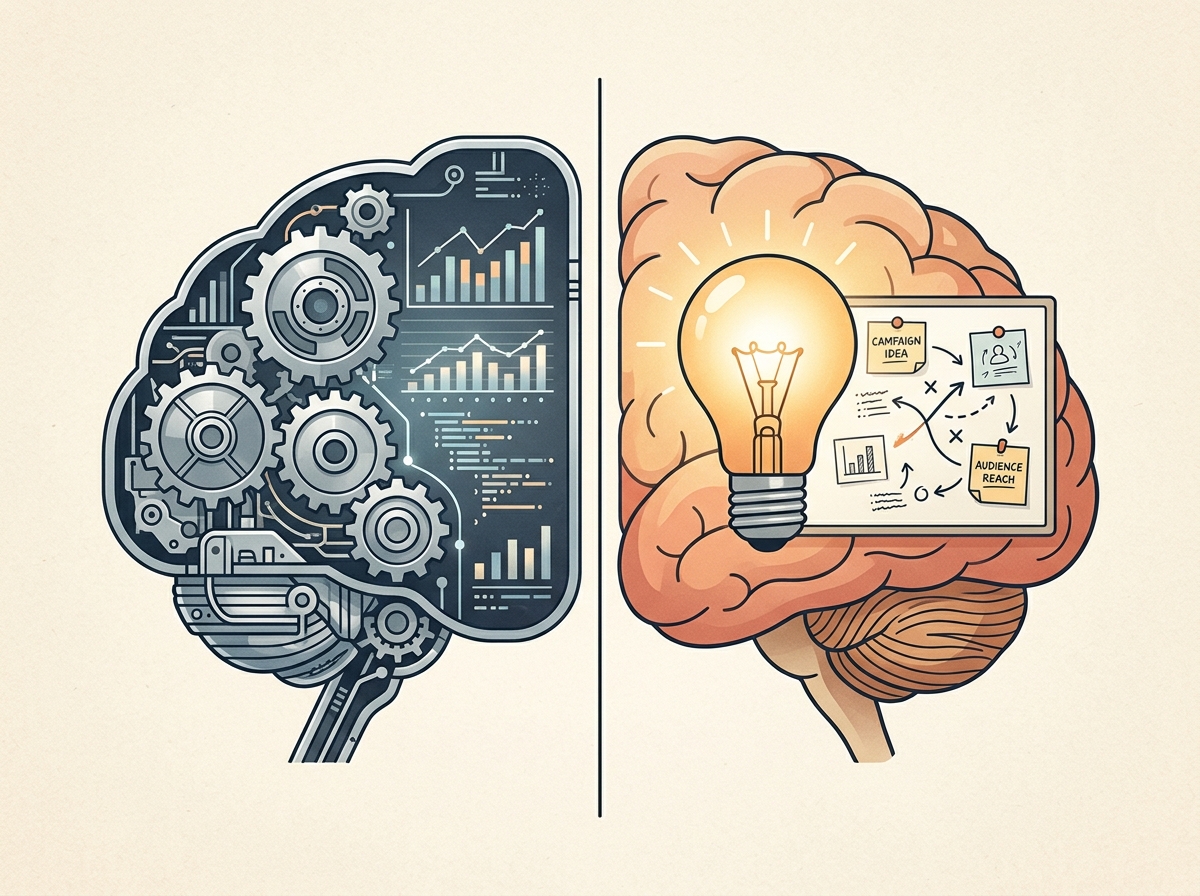
While AI excels at optimization, it lacks strategic context and business awareness. It follows instructions literally, which can lead to costly errors if those instructions are misaligned with your actual business goals.
It Optimizes for the Wrong Metrics
An AI tasked with maximizing clicks will find people who click, not necessarily people who buy. If you optimize for purchases, it will find purchasers—but it won't distinguish between a high-margin sale and a low-margin, high-return order unless you provide that data. Without knowledge of your costs, shipping, or return rates, a campaign with a high ROAS can still be unprofitable.
It Can Attract Irrelevant Traffic
The broad reach of Performance Max and automated audience expansion can expose your ads to irrelevant search terms and user segments if not properly constrained. Consistent monitoring of search term reports and the use of negative keywords and brand exclusions are critical safety measures.
It Requires Sufficient Data to Learn
AI campaign performance is notoriously volatile in new ad accounts. Without a baseline of conversion data, the algorithms have no reliable signals to learn from, leading to erratic results until tracking is stable and sufficient data has been collected.
It Cannot Define Your Strategy
AI doesn't understand your brand's voice, your current promotional calendar, or your long-term business objectives. The core strategic decisions—your offer, your pricing, your brand messaging—remain entirely human responsibilities and have a greater impact on outcomes than any automated tweak.

Your New Role: Managing Inputs and Guardrails
As AI takes over tactical execution, the advertiser's role shifts to strategy and oversight. Your primary job is now to provide the AI with high-quality inputs and establish clear boundaries to prevent it from making unprofitable decisions.
| AI Handles | You Handle |
|---|---|
| Audience selection and targeting | The core offer and product strategy |
| Real-time bidding in each auction | Profit-driven targets (e.g., break-even ROAS/CPA) |
| Placement and channel distribution | Creative strategy, hooks, and messaging |
| Budget shifts across ad sets | Overall budget and scaling decisions |
| Automated creative variations | Brand voice, compliance, and claims |
| Conversion modeling and estimation | Clean data inputs via server-side tracking |
A Checklist for Using AI Advertising Safely
- Solidify Your Tracking: Ensure your Meta Pixel and Conversions API or Google's enhanced conversions are implemented correctly. Accurate data is the foundation of effective AI optimization.
- Optimize for Business Value: Always optimize for final business outcomes like purchases or qualified leads, not top-of-funnel metrics like clicks or traffic.
- Set Profit-Based Targets: Define your break-even ROAS or CPA based on your product margins and operational costs. Give the AI a clear definition of success.
- Provide Creative Diversity: Feed the algorithms with genuinely different creative concepts, not just minor variations of the same ad. Refresh creative assets regularly to avoid audience fatigue.
- Establish Clear Guardrails: Use negative keywords, brand safety exclusions, and firm budget caps to limit the AI's ability to spend inefficiently.
- Conduct Weekly Reviews: Dedicate time each week to review search term reports, placement performance, and cost per result against your break-even targets.
The Next Evolution: AI Agents
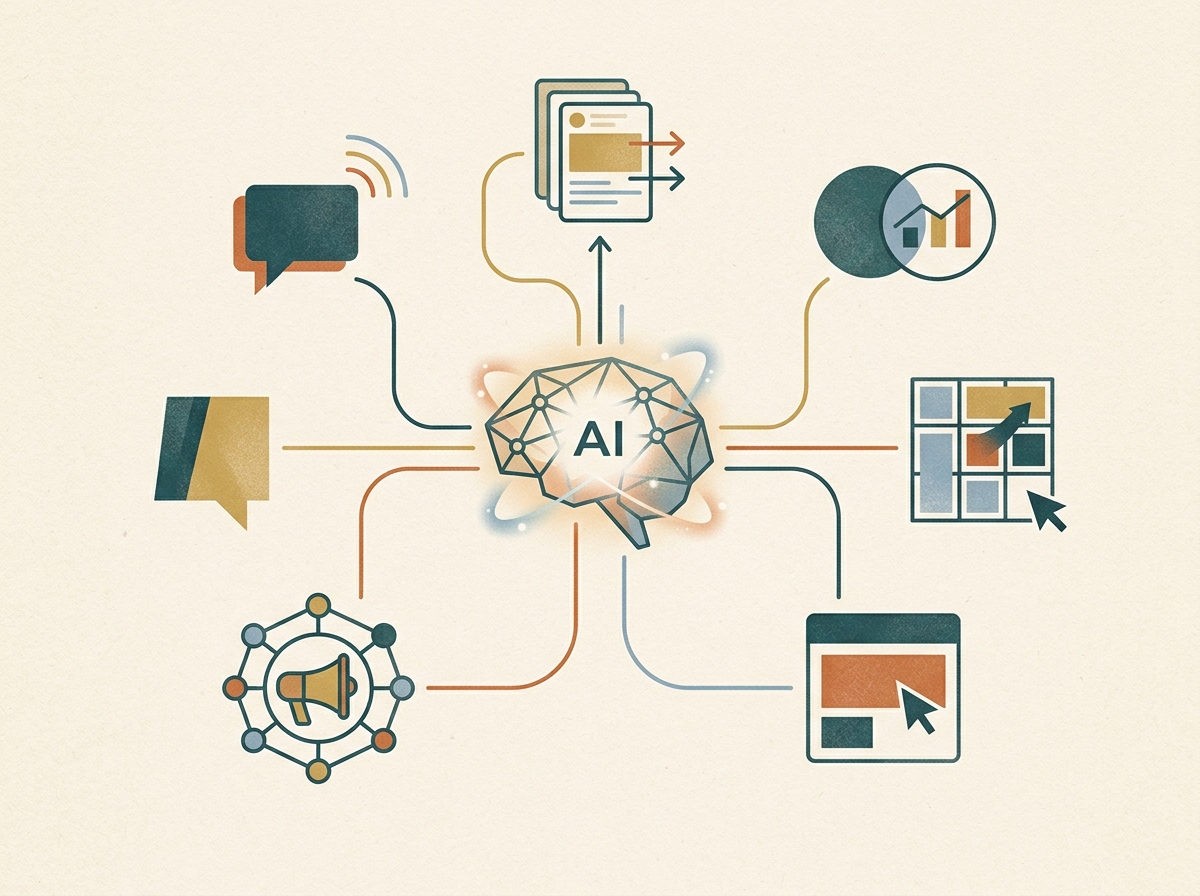
The AI built into ad platforms optimizes within its own ecosystem. The next layer of technology involves AI agents that operate across multiple platforms. These tools function like an automated performance marketer, analyzing results from Meta, Google, and others, reallocating budget between them, and making optimization decisions based on a unified view of performance, all within constraints you define.
How to Evaluate an AI Agent
Before entrusting a third-party AI with your ad spend, ask critical questions about its operation:
- Profit-Driven Optimization: Does the agent optimize based on your actual costs and profit margins, or just platform-level metrics?
- Transparency and Control: Can you review every change the agent makes and understand its reasoning? Can you set firm limits on its spending and the types of changes it can make?
Frequently asked questions
Will AI replace digital marketers?
AI is automating the manual, repetitive tasks of ad management, such as bid adjustments and audience building. This shifts the role of a digital marketer toward strategy, creative direction, data analysis, and ensuring that AI-driven campaigns align with overarching business goals for profitability.
Is AI targeting more effective than manual targeting?
In most cases where an account has sufficient conversion data and accurate tracking, broad AI-powered targeting now consistently outperforms narrow, manually selected audiences. However, it can perform poorly in accounts with limited data or broken tracking infrastructure.
Can AI write and design ads from scratch?
AI tools are excellent for generating copy drafts, creating variations of existing images, and adapting creative to different formats. However, the most compelling ads still originate from a human-driven strategy that incorporates genuine customer insights, unique brand messaging, and authentic product visuals.
What are the primary risks of using AI in advertising?
The main risks include optimizing for metrics that don't correlate with profit, wasting budget on irrelevant search terms or audiences, a lack of transparency into algorithmic decisions, and the potential for AI-generated creative to violate brand guidelines or ad policies. These risks can be managed with strong guardrails and regular human oversight.